If you have ever wanted to invest your money but felt that the stock market was too complicated, you are not alone.
You may have heard people talk about mutual funds, SIPs, NAV, equity funds, debt funds, expense ratios and direct plans. After a while, it can feel like you need a finance degree just to understand where your money is going.
You don’t.
What is a mutual fund? At its simplest, it is a way for many people to pool their money and invest it in a portfolio of investments such as shares, bonds and other securities.
But that definition doesn’t really answer the question most beginners have:
If I put ₹5,000 into a mutual fund, what actually happens to my money?
Let’s start there.
What Is a Mutual Fund in Simple Words?
Imagine 1,000 people each put ₹1,000 into a common pool.
Together, they have ₹10 lakh.
Instead of every person trying to decide which shares, bonds or other investments to buy, the pooled money is invested according to the objective of the mutual fund scheme.
You don’t personally pick every investment sitting inside the fund.
Instead, you own units of the mutual fund.
The value of those units changes depending on how the investments held by the fund perform.
That’s the basic idea.
For example, suppose you invest ₹5,000 in an equity mutual fund.
The fund may invest the pooled money in shares of several companies. You don’t have to personally buy those shares one by one.
If the value of the investments held by the fund increases, the value of your investment can increase. If those investments fall, your investment can fall too.
So a mutual fund isn’t a fixed deposit with a guaranteed return.
It is an investment whose value can go up and down.
How Does a Mutual Fund Work?
The process is easier to understand than the terminology makes it sound.
You put money into a mutual fund scheme.
↓
Your money is pooled with money from other investors.
↓
The fund invests that money according to its stated objective.
↓
The investments rise or fall in value.
↓
The value of your units changes.
That’s essentially what is happening behind the scenes.
A fund manager and investment team manage the portfolio according to the scheme’s rules and objectives.
For example, an equity fund may invest mainly in shares, while a debt fund may invest mainly in bonds and other fixed-income securities.
This means you aren’t simply handing your money to someone and saying, “Do whatever you want with it.”
Every mutual fund scheme has a stated investment objective and strategy.
That’s one of the first things you should understand before investing. If you’re still wondering what a mutual fund actually does with your money, the process is easier to understand than the terminology makes it sound.
What Do You Actually Own?
This is an important point that often gets lost in beginner articles.
Suppose you invest ₹10,000 in a mutual fund.
You don’t directly become the owner of 17 shares of one company, 23 shares of another company and some bonds.
Instead, you receive units of the mutual fund scheme.
The scheme itself holds the underlying investments.
Your units represent your share in the scheme.
Think of it like a large basket.
The basket contains many investments.
You own a portion of the basket rather than personally owning every item in it.
This is one reason mutual funds can be convenient for people who don’t want to select and manage individual investments themselves.
What Is NAV?
NAV stands for Net Asset Value.
For a beginner, the easiest way to think about NAV is:
The value of one unit of a mutual fund scheme.
Suppose a mutual fund has an NAV of ₹25.
If you invest ₹5,000, you would receive approximately:
₹5,000 ÷ ₹25 = 200 units
Now suppose the NAV rises to ₹30.
Your 200 units would then be worth approximately:
200 × ₹30 = ₹6,000
If the NAV falls to ₹20, they would be worth approximately ₹4,000.
One common mistake is to think that a mutual fund with a lower NAV is “cheaper” than one with a higher NAV.
That’s not how it works.
A fund with an NAV of ₹20 isn’t automatically cheaper or better than a fund with an NAV of ₹200.
The NAV simply tells you the value per unit. You need to look at the underlying portfolio, objective, costs and risks to understand the investment.
How Do You Make Money From a Mutual Fund?
There isn’t a fixed amount that a mutual fund pays you every month or every year.
Your investment can grow when the investments held by the scheme increase in value.
For example, you invest ₹50,000 and, after some time, the value becomes ₹65,000.
Your investment has increased by ₹15,000.
But the opposite can happen too.
If the value of the underlying investments falls, your ₹50,000 could temporarily become ₹45,000, ₹40,000 or even less.
This is why it is important to understand that mutual funds are investments, not guaranteed-return products.
The return you eventually earn depends on the performance of the investments and the period for which you remain invested.
What Are the Different Types of Mutual Funds?
Now that you understand what a mutual fund is, the next question is what kind of mutual fund you can invest in.
Don’t try to memorise all of them in one sitting.
For a beginner, it helps to first understand three broad groups.
Equity Mutual Funds
Equity funds invest primarily in shares and equity-related securities.
Because share prices can move considerably, these funds can experience significant ups and downs.
Within equity funds, you’ll come across categories such as large-cap, mid-cap, small-cap, multi-cap, index, sectoral and thematic funds.
These are not interchangeable.
A fund investing across a broad range of companies can behave very differently from one that concentrates on a particular sector.
So don’t assume that every equity mutual fund has the same level of risk.
Debt Mutual Funds
Debt funds invest primarily in instruments such as bonds and other debt securities.
Their risks are different from those of equity funds.
For example, the value of debt investments can be affected by changes in interest rates and by the ability of borrowers or issuers to repay their obligations.
This is why calling all debt funds “safe” can be misleading.
They may behave differently from equity funds, but that doesn’t mean there is no risk.
Hybrid Mutual Funds
Hybrid funds combine different asset classes, commonly equity and debt.
The proportion can vary depending on the scheme.
Some may have a larger equity component, while others may have more debt.
The idea is to combine different types of investments within the same scheme.
There are also other categories, including index funds, ETFs, solution-oriented schemes and fund-of-funds.
As a beginner, you don’t need to know every category before you start learning about mutual funds.
The important question is:
Where does this particular fund invest my money, and what risks come with it?
What Is SIP?
SIP stands for Systematic Investment Plan.
It is a method of investing a fixed amount into a mutual fund at regular intervals.
For example, you might invest ₹3,000 every month.
Here’s an important distinction:
A mutual fund is the investment. SIP is a way of investing in it.
So when someone says:
“I invest in SIP.”
What they usually mean is:
“I invest in a mutual fund through a SIP.”
You can also invest a lump sum instead of using a SIP.
Does SIP Guarantee Returns?
No.
This is one of the biggest misconceptions beginners have.
A SIP doesn’t guarantee 10%, 12%, 15% or any other return.
Your money is still invested in the mutual fund.
If the underlying investments fall, the value of your investment can fall.
What a SIP does is help you invest regularly rather than trying to decide when to put a large amount into the market.
It can also make investing a habit.
That’s useful, but it isn’t a guarantee of profit.
What Is an Expense Ratio?
Running a mutual fund involves costs.
There are expenses related to managing the portfolio, administration, operations, custody, accounting and other activities.
These costs are reflected in the fund’s expense ratio.
It is expressed as a percentage of the fund’s assets.
You generally don’t receive a separate monthly bill for it.
Instead, the expenses are accounted for within the scheme and affect the value of your investment.
For a long-term investor, even seemingly small differences in costs can become meaningful over many years.
This is one reason you shouldn’t look only at a fund’s past returns.
Direct vs Regular Mutual Funds
You will probably come across the terms Direct Plan and Regular Plan when you start researching mutual funds.
Both can belong to the same mutual fund scheme and have the same underlying portfolio, but their cost structures differ.
If you want to understand exactly how these two plans differ, including their costs, NAV, returns and the role of a distributor, read our detailed guide on the difference between direct and regular mutual fund plans
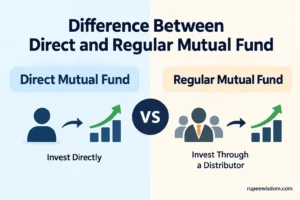
The main difference is how you invest.
Direct plan
You invest directly without going through a distributor.
Because there is no distributor commission in the expense structure, direct plans generally have a lower expense ratio.
Regular plan
You invest through a distributor or intermediary.
The cost structure includes distribution-related expenses, so the expense ratio is generally higher.
But don’t turn this into another simplistic rule:
“Direct is always better.”
Direct plans can be attractive if you’re comfortable researching and managing your investments yourself.
A regular plan may involve an intermediary who provides assistance or guidance.
The important thing is to understand what you’re paying and why.
What Is the Riskometer?
When you look at a mutual fund scheme, you’ll see a Riskometer showing its level of risk.
The categories range from:
- Low
- Low to Moderate
- Moderate
- Moderately High
- High
- Very High
This is designed to give investors a quick indication of the scheme’s risk level.
But don’t treat it as a promise.
A “Very High” risk fund doesn’t mean it will definitely lose money.
And a fund with a lower risk rating doesn’t mean you cannot lose money.
It is an indicator, not a prediction of what will happen next.
Why Do People Invest in Mutual Funds?
There are several reasons mutual funds are popular.
Diversification
A scheme may invest in a number of securities instead of putting everything into one company or one investment.
This can reduce the impact of one investment performing badly.
However, diversification doesn’t eliminate risk. A fund that focuses on one sector or theme, for example, can still be highly concentrated.
Professional management
The portfolio is managed by a fund manager and investment team according to the scheme’s objective.
Convenience
You don’t have to personally research and buy every security held by the fund.
Accessibility
Mutual funds allow investors to participate in a portfolio of investments without needing a very large amount of money to begin.
Variety
There are funds designed around different investment objectives, asset classes and strategies.
That variety is useful, but it can also become confusing.
More choice isn’t always better when you don’t understand what you’re buying.
What Are the Risks of Mutual Funds?
Before talking about the possible returns, let’s talk about what can go wrong.
Market risk
The value of shares and other market-linked investments can fall.
Credit risk
A debt investment may face problems with repayment or may suffer a decline in credit quality.
Interest-rate risk
Changes in interest rates can affect the value of many debt investments.
Concentration risk
A fund that invests heavily in a particular company, sector, theme or type of asset can be affected more severely if that area performs badly.
Behavioural risk
This one is often ignored.
You might buy a fund when markets are doing well and then sell in panic when markets fall.
The fund may recover later, but you have already turned a temporary fall into an actual loss.
Sometimes the biggest problem isn’t the investment.
It’s the investor.
Is a Mutual Fund the Same as Buying Shares?
No.
When you buy shares of a company directly, you are investing directly in that company.
When you invest in a mutual fund, your money is pooled with money from other investors and invested according to the scheme’s objective.
The fund may hold shares of dozens or even hundreds of companies, depending on its strategy.
So the difference is quite simple:
Buying shares directly: You select the companies.
Investing through a mutual fund: You select the fund scheme, and the scheme manages the portfolio according to its stated strategy.
Neither approach is automatically “better.”
They are simply different ways of investing.
How Much Money Do You Need to Start?
There is no single amount that applies to every mutual fund.
Minimum investment amounts depend on the scheme and the investment route.
But don’t get too focused on finding the smallest possible amount.
The more important question is:
Can you invest this money without putting your basic financial needs at risk?
For example, if you are struggling to pay your credit-card bills or have no emergency savings, starting a SIP just because someone on social media told you to may not be the best first step.
Investing is important.
But it is not a substitute for financial stability.
If you’re completely new to investing and want to understand the bigger picture — including how to prepare financially, how much you might invest, and the different options available — read our How to Start Investing in India guide.
Do You Need a Demat Account to Invest in Mutual Funds?
Not necessarily.
You can invest in mutual funds without having a demat account, depending on the route you use.
Mutual funds can be purchased through fund houses and various registered investment platforms and intermediaries.
A demat account is more commonly associated with holding securities such as shares and certain exchange-traded investments.
So:
No demat account does not mean you cannot invest in mutual funds.
What Should a Beginner Check Before Investing?
You don’t need a complicated 30-point checklist.
Start with a few basic questions.
1. What does the fund invest in?
Look at its portfolio and understand the type of assets it holds.
2. What is the fund’s objective?
Understand what the scheme is actually trying to achieve.
3. What is the risk level?
Check the Riskometer and understand what the risk means.
Before investing, it’s also worth understanding the information available to investors and what to check in a mutual fund scheme. SEBI Investor – Mutual Funds
4. What does it cost?
Look at the expense ratio and understand whether you’re considering a direct or regular plan.
5. How long can you stay invested?
A fund suitable for a long-term goal isn’t automatically suitable for money you’ll need in six months.
6. What could go wrong?
This is a surprisingly useful question.
Don’t look only at:
“How much return did this fund give?”
Also ask:
“What could make this investment perform badly?”
That gives you a much more realistic picture.
Once you understand the basics, you may come across terms such as alpha, which is used to discuss how a mutual fund has performed compared with its benchmark. If you want to understand what this number actually means and why it matters, read our guide on What Is Alpha in Mutual Funds.
A Simple Mutual Fund Example
Let’s put everything together.
Suppose Rahul earns ₹60,000 a month.
After taking care of his regular expenses and setting aside money for emergencies, he decides to invest ₹5,000 every month in a mutual fund through a SIP.
His ₹5,000 doesn’t sit in a separate account earning a fixed interest rate.
Instead:
Rahul invests ₹5,000
↓
The money enters the mutual fund scheme
↓
His money is pooled with money from other investors
↓
The fund invests according to its objective
↓
The underlying investments change in value
↓
The NAV changes
↓
The value of Rahul’s units changes
That’s the basic mechanism.
Once you understand this, the terminology becomes much less intimidating.
Mutual Funds Are Not a Shortcut to Easy Money
This is perhaps the most important lesson for a beginner.
A mutual fund can make investing more convenient.
It can provide diversification.
It can give you access to professionally managed portfolios.
A SIP can help you invest regularly.
But none of these things means that your money is guaranteed to grow.
Markets can fall.
Returns can be disappointing.
A particular investment strategy can remain out of favour for years.
And investors can make emotional decisions.
So don’t invest in something simply because somebody says:
“This fund gave 20% last year.”
Past performance is not a promise of future returns.
Before looking at returns, understand what you are investing in and why.
Mutual Fund vs SIP: The Easy Way to Remember It
If you’re still mixing up these two terms, remember this:
| Mutual Fund | SIP |
|---|---|
| Investment scheme | Method of investing |
| Can invest in equity, debt, hybrid and other assets | Usually involves regular investments |
| You own units | Determines how you contribute |
| Value can rise or fall | Does not guarantee returns |
| Can be bought through lump-sum investment | Can be used for periodic investments |
So, a mutual fund and a SIP aren’t competing investment products.
One is what you invest in.
The other is how you invest.
Frequently Asked Questions
Is a mutual fund safe?
There is no simple “safe” or “unsafe” answer.
Different mutual funds have different risks depending on what they invest in. Equity funds, debt funds and hybrid funds can behave very differently.
Can I lose money in a mutual fund?
Yes.
The value of your investment can fall when the underlying investments decline.
Is SIP a mutual fund?
No.
SIP is a method of investing regularly in a mutual fund scheme.
Is a mutual fund better than an FD?
They serve different purposes and have different characteristics.
An FD generally provides a predetermined interest rate for the agreed period, subject to its terms. A mutual fund’s returns are market-linked and are not guaranteed.
So “better” depends on what you’re trying to achieve.
Is a mutual fund the same as a stock?
No.
A stock represents ownership in an individual company. A mutual fund pools investors’ money and invests it according to the scheme’s objective.
What is NAV?
NAV means Net Asset Value. It represents the value of one unit of a mutual fund scheme.
What is an expense ratio?
It is the percentage of a mutual fund’s assets used toward the expenses of operating and managing the scheme.
What is the difference between direct and regular mutual funds?
Both can belong to the same scheme and have the same underlying portfolio, but direct plans do not involve a distributor and generally have a lower expense ratio. Regular plans are distributed through intermediaries and have a different cost structure.
Can I invest in mutual funds without a demat account?
Yes. A demat account is not necessarily required to invest in mutual funds.
The Bottom Line
If someone asks you what a mutual fund is, you should be able to explain it without using complicated financial jargon. A mutual fund isn’t a magic box where you put ₹5,000 and wait for it to become ₹10,000.
It is simply a pooled investment structure.
Many investors put money into a scheme. The money is then invested according to that scheme’s objective. You receive units, and the value of those units changes as the underlying investments change.
Once you understand that basic idea, terms such as NAV, SIP, expense ratio, equity fund, debt fund, direct plan and regular plan become much easier to understand.
And that’s where a beginner should start.
Don’t begin with:
“Which mutual fund should I buy?”
Begin with:
“What am I actually investing in?”
Once you understand that, you’re in a much better position to make sense of the thousands of mutual-fund options available in India.