
Planning to apply for an Ayushman Card? The first step is keeping the right documents ready.
Many applications are delayed or rejected simply because applicants upload the wrong document, provide mismatched details, or don’t know what proof is actually required.
The good news is that applying for an Ayushman Card isn’t complicated if you’re prepared. Whether you’re applying online, visiting a Common Service Centre (CSC), or registering at a hospital, having the correct documents can save you multiple trips and unnecessary delays.
In this guide, you’ll find the complete list of Ayushman Card documents required in 2026, who needs which documents, optional documents that may help, and common mistakes you should avoid before submitting your application.
What Is an Ayushman Card?
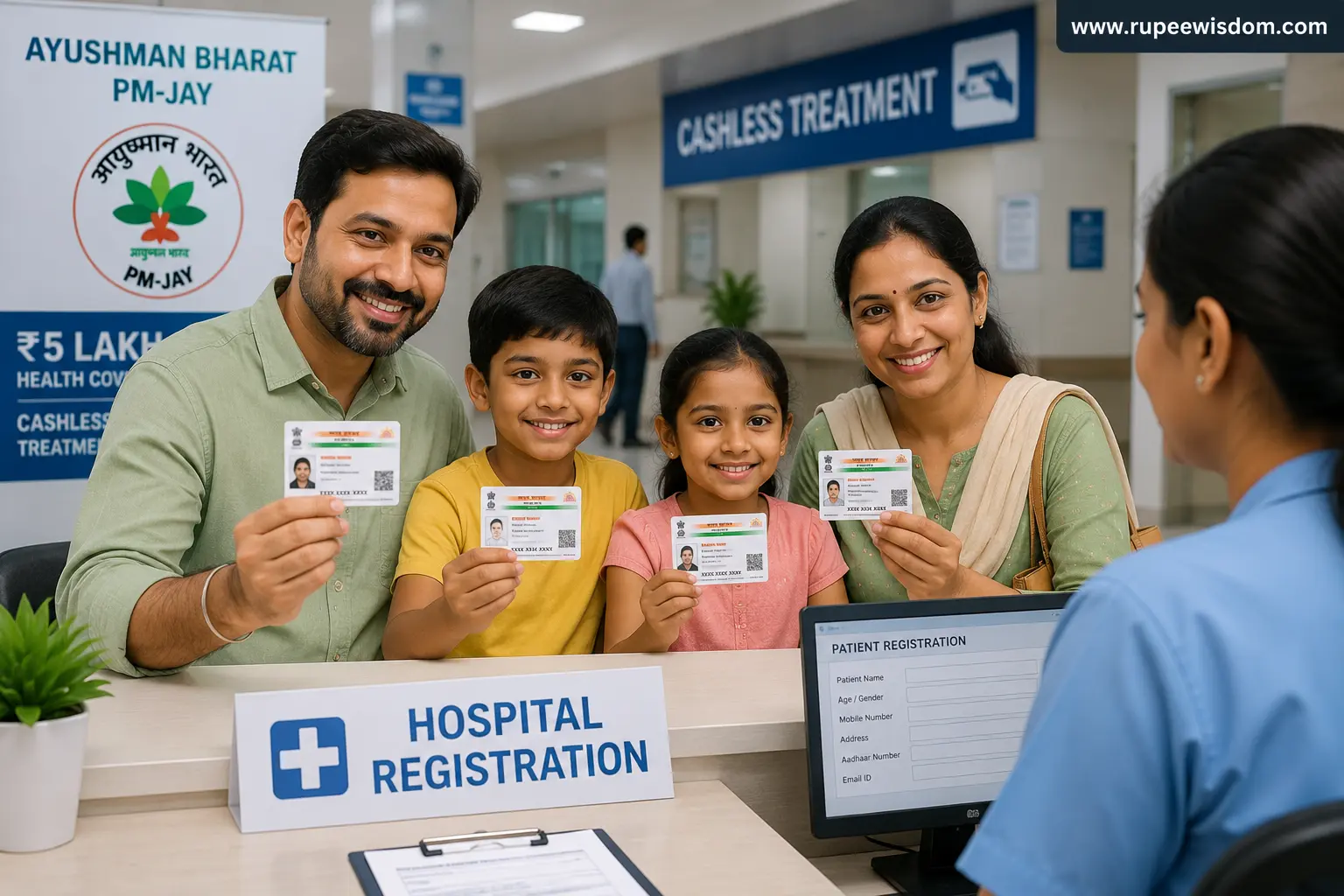
An Ayushman Card is issued under the Ayushman Bharat Pradhan Mantri Jan Arogya Yojana (AB-PMJAY), one of India’s largest government health insurance schemes.
The card allows eligible beneficiaries to receive cashless treatment at empanelled government and private hospitals across India. Depending on eligibility, families can receive health coverage of up to ₹5 lakh per year for various secondary and tertiary medical treatments.
However, remember that not everyone is automatically eligible. Your name must appear in the beneficiary database or you must qualify under the applicable government rules.
Related Reading:
Not everyone qualifies for Ayushman Bharat. If you’re looking for health coverage outside the scheme, check out our detailed guide on the best health insurance plans for families in India.
Ayushman Card Documents Required in 2026
Before starting your application, keep the following documents ready. Carry original documents whenever possible, especially if you’re visiting a CSC or hospital.
| Document | Mandatory | Purpose |
|---|---|---|
| Aadhaar Card | ✔ Yes | Identity verification and e-KYC |
| Mobile Number linked with Aadhaar | ✔ Usually | OTP verification |
| Ration Card (if applicable) | ✔ In many cases | Family verification |
| Family ID / Household ID (State specific) | Sometimes | Beneficiary verification |
| Address Proof | Sometimes | Residential verification |
| Passport Size Photograph | Sometimes | Card generation |
| PAN Card | Optional | Additional identity proof (generally not mandatory) |
| Voter ID | Optional | Alternate identity proof |
| Driving Licence | Optional | Identity verification where accepted |
Although Aadhaar is the most commonly required document, additional documents may vary slightly depending on your state and the verification method used.
Aadhaar Card – The Most Important Document
Your Aadhaar Card is usually the primary document required for creating an Ayushman Card.
It helps authorities verify:
- Your identity
- Date of birth
- Gender
- Photograph
- Aadhaar-based e-KYC
Before applying, check that:
- Your Aadhaar details are correct.
- Your mobile number is linked to Aadhaar.
- Your biometric details are updated if required.
Even a small spelling mismatch between your Aadhaar and beneficiary records can delay verification.
Mobile Number Linked with Aadhaar
Many applicants overlook this requirement.
During online verification, an OTP is often sent to the mobile number registered with Aadhaar. Without access to this number, completing e-KYC may become difficult.
If your Aadhaar-linked mobile number is inactive, consider updating it before applying.
Ration Card
A ration card is commonly used to verify family members listed under a household.
It helps officials confirm:
- Family relationships
- Household details
- Beneficiary matching
In several states, the ration card remains one of the most useful supporting documents during verification.
Family ID or Household ID
Some states have introduced their own family identification systems.
Examples include:
- Family ID
- Samagra ID
- Household ID
- State resident database numbers
If your state uses one of these systems, keeping the ID handy can speed up the verification process.
Address Proof
While Aadhaar usually contains your address, officials may sometimes ask for additional proof if there is a mismatch.
Accepted address proof may include:
- Electricity bill
- Water bill
- LPG connection document
- Bank passbook
- Registered rent agreement
- Government-issued residence certificate
The exact list may vary depending on the verification centre.
Passport Size Photograph
Although many centres capture a live photograph during registration, some locations may still request a recent passport-size photograph.
Carry two or three recent photographs to avoid unnecessary delays.
Are PAN Card and Voter ID Mandatory?
No.
Many people assume PAN Card is compulsory because it is required for various financial services.
For an Ayushman Card application, PAN Card is generally not mandatory.
However, officials may accept additional government-issued identity documents such as:
- PAN Card
- Voter ID
- Driving Licence
- Passport
These usually act as supporting documents rather than primary proof.
Documents Required for Different Categories of Applicants
Not every applicant has the same documentation requirements.
Rural Families
Applicants from rural areas generally require:
- Aadhaar Card
- Ration Card
- Mobile number
- Beneficiary verification
Eligibility is often determined using socio-economic data available with the government.
Urban Families
Urban beneficiaries typically need:
- Aadhaar
- Mobile number
- Address verification
- Supporting identity documents where necessary
Senior Citizens
Senior citizens should keep:
- Aadhaar Card
- Recent photograph
- Mobile number (their own or a family member’s, if permitted)
- Any additional proof requested during verification
If biometric authentication becomes difficult due to age, officials may use alternative verification methods wherever permitted.
Women Applicants
Women should ensure that their Aadhaar details, especially their name and date of birth, match the beneficiary records.
If the surname has changed after marriage, supporting documents may sometimes be required to resolve discrepancies.
Adding Family Members
When adding a spouse, child, or other eligible family member, you may need documents that establish the relationship.
Depending on the situation, these may include:
- Ration Card
- Family ID
- Birth Certificate (for children)
- Aadhaar Cards of family members
Officials may also verify family details using government databases.
Common Reasons Ayushman Card Applications Get Rejected
Many applications are rejected for avoidable reasons rather than ineligibility.
Some of the most common issues include:
Aadhaar Details Do Not Match
A spelling mistake, incorrect date of birth, or different gender information can prevent successful verification.
Incorrect Mobile Number
If the OTP cannot be received, completing Aadhaar authentication becomes difficult.
Poor Quality Document Uploads
Blurred scans, cropped images, or unreadable documents often delay processing.
Use clear, colour copies whenever uploading documents online.
Name Not Found in Beneficiary Database
Even if you possess all the required documents, your application may not proceed if your household is not listed as an eligible beneficiary under the scheme.
This is one of the most misunderstood aspects of the Ayushman Bharat scheme.
Duplicate Records
Multiple entries with similar information may trigger manual verification and increase processing time.
Quick Checklist Before You Apply
Before starting your application, make sure you have:
✔ Aadhaar Card
✔ Aadhaar-linked mobile number
✔ Ration Card (if applicable)
✔ Address proof
✔ Passport-size photographs
✔ Family ID (where applicable)
✔ Original documents for verification
How to Apply for an Ayushman Card in 2026
Once you have the required documents ready, applying for an Ayushman Card is fairly straightforward. You can complete the process online in eligible cases or visit an authorised centre for assistance.
Option 1: Apply Online
If you’re eligible, you can begin the process through the official Ayushman Bharat beneficiary portal.
The typical steps are:
- Visit the official PM-JAY beneficiary portal.
- Log in using your mobile number and OTP.
- Search for your name using your mobile number, Aadhaar number, Family ID, or other available details.
- Verify your identity through Aadhaar e-KYC.
- Upload any supporting documents if requested.
- Submit the application for verification.
- Download your Ayushman Card once it is approved.
Tip: Use only the official government portal to avoid scams or fake websites asking for payment.
Option 2: Apply Offline at a CSC or Hospital
Many people prefer visiting a Common Service Centre (CSC) or an empanelled hospital, especially if they’re not comfortable applying online.
Carry your original documents, including:
- Aadhaar Card
- Ration Card (if applicable)
- Mobile phone
- Passport-size photographs (if available)
- Any additional documents requested by your state
The operator will verify your details, complete your e-KYC, and help generate your Ayushman Card if you’re eligible.
Documents Required at the Hospital for Cashless Treatment
Many people think they only need documents while creating the Ayushman Card. In reality, you’ll also need certain documents when visiting a hospital for cashless treatment.
Keep these ready:
| Document | Purpose |
|---|---|
| Ayushman Card | Beneficiary identification |
| Aadhaar Card | Identity verification |
| Doctor’s Prescription (if available) | Medical assessment |
| Previous Medical Records | Helps doctors understand your condition |
| Referral Letter (if required) | For specific treatments or hospitals |
The exact documents may vary depending on the treatment and hospital’s admission process.
Do Document Requirements Differ Across States?
Yes, they can.
While PM-JAY is a central government scheme, several states integrate it with their own health insurance programmes or maintain separate beneficiary databases.
As a result, some states may ask for additional documents such as:
- Family ID
- State Resident Certificate
- Samagra ID
- Ration Card
- State-issued health card
- Household identification number
If you’re unsure, it’s best to check the requirements with your nearest CSC or empanelled hospital before visiting.
Tips to Avoid Application Rejection
Submitting the correct documents is only half the job. Small mistakes can delay your application or require you to start the process again.
Here are a few practical tips:
1. Ensure Your Aadhaar Details Are Updated
If your name, date of birth, gender, or address has changed recently, update your Aadhaar before applying.
2. Use the Mobile Number Linked to Aadhaar
Most online verification relies on OTP authentication. Without access to the registered mobile number, verification may become difficult.
3. Upload Clear Documents
Avoid:
- Blurry photos
- Cropped images
- Black-and-white scans
- Documents with missing edges
A clear, colour image improves the chances of smooth verification.
4. Carry Original Documents
Even if you’ve uploaded digital copies online, officials may ask to see the originals during verification.
5. Check Eligibility Before Applying
Many applicants spend time collecting documents only to discover they’re not eligible under the scheme.
Checking your eligibility first can save considerable effort.
Myths About Ayushman Card Documents
There are plenty of misconceptions circulating on social media. Let’s clear up a few.
Myth: PAN Card is compulsory.
Reality: No. Aadhaar is generally the primary identity document. PAN is usually optional.
Myth: Everyone in India automatically gets an Ayushman Card.
Reality: Eligibility depends on government criteria and beneficiary databases. Not everyone qualifies.
Myth: You have to pay to get an Ayushman Card.
Reality: The card itself is issued under a government scheme. Be cautious if anyone demands unofficial charges.
Myth: Only government hospitals accept the Ayushman Card.
Reality: Many private hospitals empanelled under PM-JAY also provide cashless treatment.
Frequently Asked Questions (FAQs)
Is Aadhaar mandatory for an Ayushman Card?
In most cases, Aadhaar is required for identity verification and e-KYC. However, specific verification processes may vary in exceptional situations.
Can I apply without a ration card?
Yes, in many cases. The exact requirements depend on your state’s verification process and beneficiary records.
Is PAN Card compulsory?
No. PAN Card is generally not a mandatory document for an Ayushman Card application.
Can I use my voter ID instead of Aadhaar?
Aadhaar remains the primary document for e-KYC. Other identity documents may be accepted as supporting proof in certain situations.
Do I need passport-size photographs?
Some centres capture your photograph digitally, while others may ask you to provide one. Carrying a few recent photographs is advisable.
Can I apply from another state?
Yes. PM-JAY provides portability across India, but document verification and enrolment procedures may vary depending on local implementation.
How long does verification take?
Processing time varies depending on the verification process and workload at the enrolment centre.
Can I download my Ayushman Card online?
Yes. Once approved, eligible beneficiaries can usually download their Ayushman Card through the official beneficiary portal.
What should I do if my application is rejected?
Check the reason for rejection, correct the issue—such as mismatched Aadhaar details or unclear documents—and apply again if permitted.
Is there an application fee?
No official application fee is charged for issuing an Ayushman Card. If you use a CSC, there may be nominal service charges as permitted under applicable rules.
Final Thoughts
Applying for an Ayushman Card becomes much easier when you keep the right documents ready before starting the process.
For most applicants, the essentials include an Aadhaar Card, a mobile number linked to Aadhaar, and, where applicable, a ration card or family identification document. Depending on your state and verification method, you may also need address proof or other supporting documents.
Before visiting a CSC or hospital, spend a few minutes checking that your details are accurate and your documents are clear and up to date. A little preparation can help you avoid delays and make the application process much smoother.