Where to Park Emergency Fund in India — this is one of the most common and important questions for anyone who earns, saves, or invests.
Emergencies never announce themselves — medical bills, job loss, or sudden home repairs can hit anytime. The difference between calm and chaos often depends on one thing: where you parked your emergency fund.
Let’s walk through how to create and store that safety net so it’s safe, instantly available, and inflation-proof.
If you haven’t started building your safety net yet, read our practical guide on how to save for an emergency fund in India.
Want a quick, practical guide?
Read our full step-by-step guide on emergency funds — clear, India-specific, and ready to use.
Read: What Is an Emergency FundWhat Makes a True Emergency Fund
Before choosing where to park an emergency fund in India, understand its core purpose. A real emergency fund should tick these boxes:
A real emergency fund should meet four basic needs:
- Easy Access: You should be able to get your money when an emergency arises. Keep some of it in a bank account for immediate expenses.
- Safety: Your emergency money should not be exposed to unnecessary market risk. Bank deposits and market-linked investments do not carry the same risks.
- Low Withdrawal Costs: Choose accounts or investments that let you access your money without significant penalties or charges.
- Reliable Availability: Your money should be accessible when you need it, including weekends or holidays for urgent expenses.
No single option offers the perfect combination of instant access, complete safety, and high returns. For an emergency fund, access to your money and protecting your savings should generally matter more than chasing higher returns.
If any of these four fail, your emergency fund isn’t doing its job.
How Much Emergency Fund Should You Keep
The ideal size depends on your lifestyle and income stability:
- Salaried employees: 3–6 months of expenses.
- Self-employed or freelancers: 6–12 months.
- Families with dependents: add a buffer for medical or education emergencies.
You can use a free calculator on the RBI Money Smart website to estimate monthly obligations and plan accordingly.
See this salary budget example for India to calculate monthly expenses.Quick Comparison: Best Places to Park Emergency Fund in India
| Option | Access to money | Main risk or limitation | Best suited for |
|---|---|---|---|
| Savings account | Usually immediate | Interest may not keep pace with inflation | Immediate emergencies |
| Sweep-in / auto-sweep FD | Depends on the bank’s terms and setup | Premature withdrawal rules and penalties may apply | Money you want to keep accessible while earning FD interest |
| Liquid mutual fund | Usually paid out on the next business day; eligibility and terms apply for instant redemption | Returns are not guaranteed and the value can fluctuate | A portion of the fund when you can accept market risk and a possible delay |
| Ultra-short-duration debt fund | Generally takes a few business days, depending on the scheme and redemption process | Interest-rate and credit risks; value can fall | People who understand debt-fund risks and do not need immediate access to this portion |
| Treasury bills (T-Bills) | Depends on maturity or the process for selling before maturity | Selling before maturity may involve price risk and settlement delays | People comfortable matching investments to a suitable maturity |
| Gold, including digital gold | Depends on the provider and selling process | Gold prices fluctuate; fees and platform risks may apply | Separate investments, not the core emergency fund |
The important distinction is that a product can be relatively low-risk without being equivalent to cash in a bank account. Mutual funds are not guaranteed-return products, and their value can fluctuate.
Where to Park Emergency Fund in India
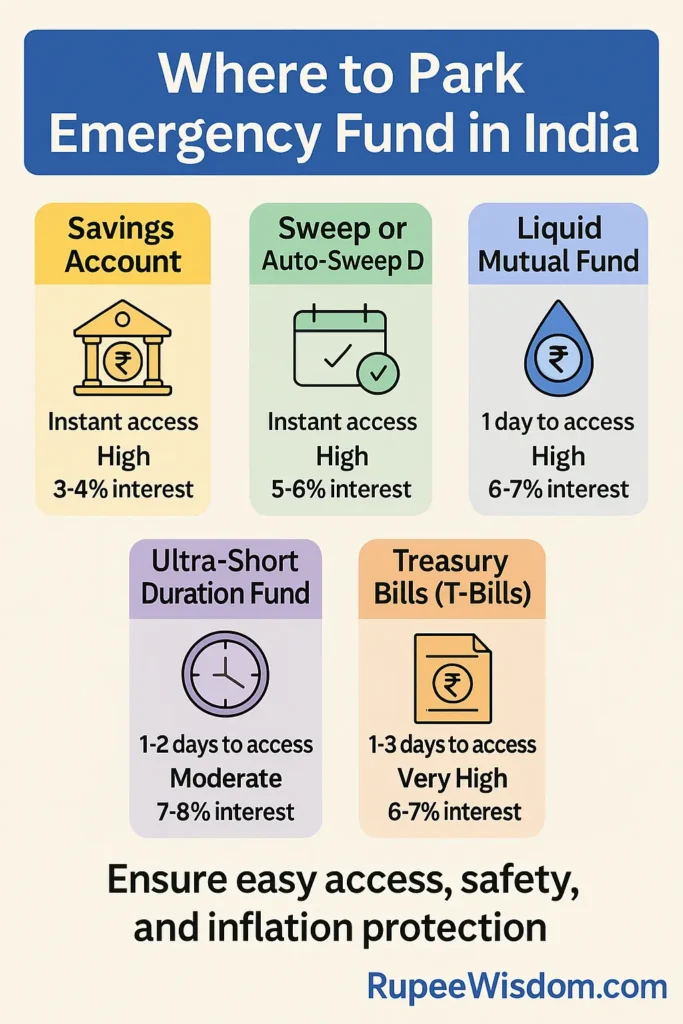
Savings Bank Account
This is your first layer of safety. Keep about one month of expenses here for instant withdrawals via ATM, UPI, or net banking.
Choose banks with good digital infrastructure and robust safety nets such as Deposit Insurance and Credit Guarantee Corporation (DICGC), which covers up to ₹5 lakh per depositor.
Avoid: parking your entire corpus here — low returns and inflation erode value fast.
Sweep-in or Auto-Sweep Fixed Deposit
Perfect for those who want both liquidity and returns.
When you withdraw, the bank may automatically break the required portion of the FD and transfer the money to your account. The process, minimum break amounts and penalties depend on the bank and the account’s terms.
Check your bank’s partial-break policy — some split FDs into chunks (₹10,000 each) to avoid penalties.
HDFC Bank’s Sweep-in FD details and SBI’s Multi Option Deposit pages explain this feature well.
Liquid Mutual Funds
These are the best place to keep emergency fund in India for most people.
Liquid mutual funds invest in short-term debt and money-market instruments. They can be one option for the portion of your emergency fund that you do not need to access immediately.
However, liquid funds are not bank deposits. Their returns are not guaranteed, and their net asset value can fluctuate. Redemption proceeds are generally paid out on the next business day, subject to the scheme’s terms and applicable rules. Some eligible schemes offer instant redemption, but limits and conditions apply.
Before investing, read the scheme’s risk information, portfolio details, expenses and redemption rules. Choose a fund only if you understand that your principal is not guaranteed. If you cannot afford even a small temporary loss or delay, keeping that money in an appropriate bank deposit may be more suitable.
Stick with reputed fund houses regulated by SEBI and cross-check schemes on AMFI.
Pro Tip: Avoid long-duration or credit-risk funds. You want stability, not excitement.
Ultra-Short Duration Debt Funds
Slightly longer tenure than liquid funds but still low risk.
These can offer marginally higher yields (7–8%) but with mild volatility.
Use them for around 10–15% of your corpus.
Check the fund’s “Modified Duration” — anything above 6 months is not ideal for an emergency corpus.
Treasury Bills (T-Bills) & Government Securities
If you’re extremely conservative, consider T-Bills or G-Secs issued by the Government of India.
They’re virtually risk-free and available via the RBI Retail Direct portal.
Liquidity takes 1–2 business days, so use them for the long-term safety portion of your fund.
Digital Gold (Tiny Portion)
Digital gold can act as a hedge against systemic risk, but never rely on it for quick access.
If you really want exposure, limit it to 5% or less of your total fund.
Use trusted platforms backed by banks or government-recognized vaults.
How to Decide Where to Park Emergency Fund in India
Before finalizing, ask yourself:
- Do I need same-day access to the entire fund?
- Am I okay with a one-day redemption delay for better returns?
- Do I prefer guaranteed returns (FD) or market-linked (funds)?
- Am I comfortable managing online investments?
If you need instant access: use a savings account or sweep FD.
If you can wait 24 hours: use a liquid fund.
If you want higher yield: keep a small slice in ultra-short funds or T-Bills.
Balancing these ensures liquidity, safety, and returns — the holy trinity of emergency fund design.
Savings Account vs Liquid Fund
| Factor | Savings Account | Liquid Fund |
|---|---|---|
| Liquidity | Instant | 1 Business Day |
| Returns | 3–4% | 6–7% |
| Risk | None | Low |
| Taxation | Income tax slab | Capital gains |
| Ideal Use | Immediate expenses | Main corpus |
For most people, a 40:60 split between savings and liquid funds works best.
Smart Allocation Strategy
A Simple Way to Organise Your Emergency Fund
Instead of following a fixed allocation, divide your emergency fund according to when you might need the money.
| Layer | Where to keep it | Purpose |
|---|---|---|
| Immediate-access money | Savings account | Medical bills, urgent travel, repairs and other expenses that cannot wait |
| Accessible reserve | Savings account or a suitable sweep-in FD | Expenses that may arise over the next few days or weeks |
| Additional reserve | A suitable liquid mutual fund, if you understand the risks | Money you may not need immediately and can wait to redeem |
| Separate investments | Outside your emergency fund | Gold, equity funds and other investments that can fluctuate in value |
The right balance depends on your household expenses, job stability, dependants, other available resources and comfort with investment risk. If you are just starting out, a simple bank-based setup is perfectly reasonable. You can consider other options once your immediate safety net is in place.
After using the fund, prioritise rebuilding it before adding money to investments that are not meant for emergencies.
Refill the fund after every withdrawal. Think of it as a permanent line of defense, not a one-time setup.
Real-Life Example
Rakesh, a 35-year-old from Pune, keeps ₹3 lakh aside for emergencies.
He parks ₹50,000 in a savings account, ₹2 lakh in a liquid fund, and ₹50,000 in a sweep FD.
When his car broke down unexpectedly, he redeemed from the liquid fund and received money within a day.
He didn’t touch credit cards or personal loans — proof that choosing where to park your emergency fund in India smartly really matters.
When to Revisit Your Emergency Fund
Inflation, income, and expenses change every year.
Reassess where to park your emergency fund in India every 6–12 months.
If your lifestyle cost rises by 10%, expand your corpus accordingly.
Also, review your bank’s FD and fund returns; shift if better options appear.
During major life events — marriage, childbirth, home purchase — upgrade your fund proportionately.
Common Mistakes to Avoid
- Treating credit cards as backup funds.
- Putting emergency money in equity or crypto.
- Ignoring inflation and taxation.
- Mixing emergency fund with travel savings.
- Not refilling after using it once.
Your emergency fund must be sacred — untouched except in true emergencies.
India-Specific Tips
- Use large banks or AMCs with solid ratings.
- Keep both online and offline access (UPI + ATM).
- Verify your FD coverage under DICGC.
- Don’t chase 0.5% higher return if it delays access.
- Document where your emergency corpus is stored; family should know too.
Pro Tips for Success
- Automate transfers each month.
- Keep the fund in a separate, clearly labeled account.
- Name the account something emotional — “Family Safety Fund” works wonders psychologically.
FAQs
1. What is the safest place to keep an emergency fund in India?
For money you may need immediately, a savings account at an insured bank is a straightforward option. A suitable sweep-in FD may help you earn more interest while retaining access, depending on the bank’s terms. Eligible bank deposits are covered by DICGC up to ₹5 lakh per depositor per insured bank, including principal and interest, subject to applicable conditions. Mutual funds do not receive this deposit-insurance protection.
2. Can I keep my emergency fund in mutual funds?
You can keep part of your reserves in a liquid mutual fund if you understand that returns are not guaranteed and the value can fluctuate. Redemption also takes time, except where eligible instant-redemption facilities apply. Keep enough money in a bank account to cover expenses that cannot wait for a redemption.
3. Is a fixed deposit a good emergency fund option?
Yes, but use sweep-in or breakable FDs for flexibility. Regular FDs lock your cash.
4. Should I hold gold or cryptocurrency as an emergency fund?
Gold and cryptocurrency should not be relied on as the core of an emergency fund. Their values can fluctuate, and the time and amount you receive when selling may be uncertain. Keep emergency reserves separate from investments whose value can fall when you need the money.
5. How much emergency fund should I maintain in 2026?
A common starting point is three to six months of essential expenses for salaried people with relatively stable incomes. If you are self-employed, have dependants, or face uncertain income, you may need a larger reserve. Consider your own obligations and risks rather than relying on a single number.
6. Can I keep my emergency fund in fintech apps?
Only if the app partners with a regulated bank or AMC under RBI or SEBI supervision. Always verify licenses on RBI’s official list.
Want to learn how to build your fund?
Read our step-by-step guide: How to Save for Emergency Fund in India — practical monthly plans, automation hacks, and milestone checkpoints to get your safety net ready fast.
Conclusion
When deciding where to park emergency fund in India, remember — no single option fits everyone.
Blend instant access with safety and modest returns.
A savings account can provide quick access to money when an emergency arises. Depending on your needs, a suitable sweep-in FD or a liquid mutual fund may help you organise the rest of your reserves, but each option has different terms and risks.
Start with accessibility and safety. Once your immediate reserve is in place, decide whether you need additional options. The aim is not to earn the highest possible return on emergency money; it is to have money available when life does not go to plan.Together, they form your financial shield against uncertainty.
Start small but start today. Build, park, and protect your fund — because when life throws surprises, your emergency fund is not just money.
It’s peace of mind.
Disclaimer: The information in this article is for educational purposes only and should not be considered financial advice. Please consult a qualified financial advisor before making any major money decisions.