
If you’ve ever wondered what is an emergency fund and why every Indian should have one, this guide simplifies it for you.
If a sudden hospital bill, job loss, or urgent car repair could throw your life off balance, then you need an emergency fund.
Many Indians confuse savings or FDs with financial safety. But when you truly need cash fast, your investments might be locked or market-linked. That’s where an emergency fund comes in — your financial shield when life hits hard.
Let’s break it down simply: what an emergency fund is, why you need it, how much to save, and how to build it step by step.
What Is an Emergency Fund? (Meaning & Purpose)
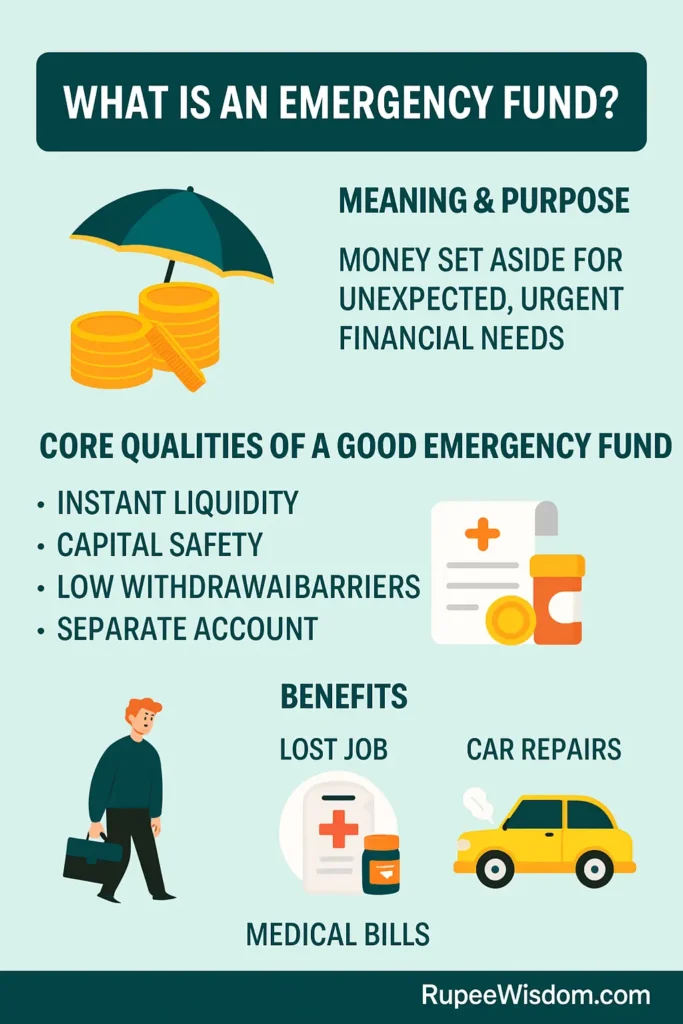
An emergency fund is money you set aside specifically for sudden and serious expenses — things like losing your job, a medical emergency, or a major repair that can’t wait.
In simple words, what is an emergency fund? It’s your go-to backup when income stops but expenses don’t.
Think of it as your financial safety cushion — you don’t touch it for vacations, weddings, or lifestyle upgrades. It’s there for survival and stability.
Core Features of a Good Emergency Fund
- Instant Liquidity: You can access it within 24 hours.
- Capital Safety: No exposure to volatile markets.
- Low Withdrawal Barriers: Easy to use without penalties.
- Separate Account: Not mixed with your everyday spending.
An emergency fund’s purpose isn’t to grow wealth. It’s to protect it.
Why an Emergency Fund Is Important in India
Understanding what an emergency fund is becomes vital in India, where job and health uncertainties are common.
In India, financial shocks can be brutal:
- Healthcare expenses rise faster than income.
- Job security isn’t guaranteed in most private sectors.
- Dependents often rely on a single earner.
- Loans and EMIs don’t pause during emergencies.
Without an emergency fund, most people turn to credit cards, payday loans, or friends — and fall into debt.
I’ve seen salaried professionals swipe credit cards to pay hospital bills and end up paying 36% interest later. That’s not a plan; that’s panic.
In India, unexpected expenses and job uncertainty make emergency planning even more critical. The Reserve Bank of India also emphasizes financial preparedness through its Financial Education Initiative, which helps citizens understand how to manage money responsibly.
Your emergency fund breaks that cycle. It buys you peace and time when life catches you off guard.
Once you understand what is an emergency fund, you realize it’s not a luxury — it’s a survival plan every Indian household needs.
How Much Emergency Fund Should You Keep?
Once you know what an emergency fund is, the next step is figuring out how much to save.
There’s no magic number, but here’s a simple rule:
Save enough to cover your essential living expenses for a few months.
Use this quick reference chart to find your sweet spot
| Type of Earner | Recommended Fund Size | Example (₹) |
|---|---|---|
| Salaried (Stable Job) | 3–6 months of expenses | ₹1–2.5 lakh |
| Self-Employed / Freelancer | 6–12 months | ₹2–5 lakh |
| With Dependents | 9–12 months | ₹3–6 lakh+ |
| Retired / Fixed Income | 12 months minimum | ₹4–8 lakh |
Calculate only must-pay expenses: rent, EMIs, groceries, medical, utilities, insurance, and transport. Exclude luxuries or holidays.
See this Salary Budget Example for India to estimate your essential expenses.
Where Should You Keep Your Emergency Fund in India?
Now that you understand what an emergency fund is, let’s explore the best places to park it safely.
The right place must be safe, liquid, and reliable.
1. Savings Account
Keep around one month of expenses in your main savings account. You can access it instantly via UPI or ATM.
Pros: Zero risk, immediate access.
Cons: Low returns (3–4%), inflation eats value.
2. Sweep-In / Auto-Sweep Fixed Deposit
A savings account linked with short FDs. Extra balance automatically converts into an FD and breaks when you withdraw.
Pros: Liquidity + better interest.
Cons: Slight penalty on premature withdrawal.
3. Liquid Mutual Funds
Best option for the main portion of your emergency fund. These funds invest in short-term government and corporate debt with next-day liquidity.
Pros: 6–7% returns, low risk.
Cons: One business day redemption delay.
4. Ultra-Short Duration Funds
Slightly higher returns (7–8%) with minimal additional risk. Keep only 10–15% of your corpus here.
5. Treasury Bills / Government Securities
Backed by the Government of India. Great for conservative savers who don’t need same-day access.
Pros: Zero credit risk.
Cons: Redemption can take 1–3 days.
6. Digital Gold (Tiny Portion)
Optional hedge. Limit it to 5% or less — it’s not for emergencies but as a hedge against currency or inflation shocks.
For detailed allocation strategies, read Where to Park Emergency Fund in India.
How to Build an Emergency Fund in India — Step-by-Step Guide
Let’s make this super practical — here’s exactly how to start, even if you’re tight on cash.
Step 1: Calculate Your Monthly Essentials
List rent, EMIs, groceries, utilities, medical expenses, and insurance premiums.
Step 2: Set a Target
Multiply your monthly essentials by 3–6 months (or 12 if self-employed).
Step 3: Start Small
Even ₹500–₹1,000 per month adds up. Consistency matters more than speed.
Step 4: Automate Savings
Set up an auto-transfer right after your salary arrives into a separate account or SIP into a liquid fund.
Step 5: Layer the Fund
Keep 15–20% in savings, 60% in liquid funds, and 20% in sweep FDs or short-term instruments.
Step 6: Use Only for True Emergencies
Medical, job loss, or unavoidable repairs — not impulse buys.
Step 7: Replenish Immediately
If you use it, rebuild it right after. Never leave the buffer empty.
Real-Life Emergency Fund Example
Ravi, a 30-year-old from Pune, earns ₹60,000 a month.
His essential expenses = ₹30,000/month.
He decides to build a 6-month emergency fund → ₹1.8 lakh.
Setup:
- ₹30,000 in savings (instant access)
- ₹1.2 lakh in liquid fund
- ₹30,000 in sweep FD
When his car engine failed, he withdrew ₹20,000 from his liquid fund and had the money the next day — no loans, no credit card EMI, no stress.
That’s how an emergency fund works in the real world.
Stories like these show what is an emergency fund in real action — it quietly saves you when everything else fails.
When you think about what an emergency fund truly means, it’s not just about money — it’s about confidence. You sleep better knowing that no matter what tomorrow brings, you’ve already built a financial cushion to protect your family and goals.
Benefits of an Emergency Fund
The biggest benefit of knowing what is an emergency fund is peace of mind.
| Situation | Without Emergency Fund | With Emergency Fund |
|---|---|---|
| Job Loss | Forced to borrow, miss EMIs | 3–6 months to recover |
| Medical Emergency | Delayed treatment, debt | Instant access to care |
| Car / Home Repairs | Budget chaos | Quick fix, no panic |
| Family Crisis | Dependence on others | Self-reliant and confident |
It’s not just financial — it’s emotional peace.
“An emergency fund doesn’t make you rich, but it keeps you from going broke when the world turns upside down.”
Common Mistakes to Avoid When Building an Emergency Fund
- Treating credit cards as an emergency fund.
- Investing the fund in high-risk products like equity or crypto.
- Forgetting to top up as expenses grow.
- Parking everything in one place.
- Not communicating with your family about access.
Your emergency fund is sacred. Guard it like your insurance policy.
When to Review Your Fund
Review it every 6–12 months.
If your expenses, dependents, or income changes, adjust your fund size.
Shift funds if your bank cuts interest rates or your mutual fund underperforms.
Life changes — your emergency fund must adapt with it.
Frequently Asked Questions
1. What is an emergency fund used for?
It’s meant for financial emergencies only — job loss, health crises, or sudden repairs.
2. How much should I have in my emergency fund?
At least 3–6 months of essential expenses; 9–12 if you’re self-employed.
3. Where should I keep my emergency fund?
Use a mix of savings account, liquid mutual funds, and sweep FDs.
4. Can I invest my emergency fund?
No. The purpose is safety, not returns. Avoid risk-based products.
5. How soon can I access my emergency fund?
Savings = instant, liquid funds = 1 day, T-Bills = 1–3 days.
Final Thoughts
So, what is an emergency fund really?
It’s your financial shock absorber — your backup when life throws the unexpected.
An emergency fund doesn’t make you rich, but it keeps you from going broke when the world turns upside down.
Start small — even ₹1,000 a month.
Protect it. Refill it. Let it give you the peace that no investment ever can.
Before you close this page, take five minutes to list your basic expenses and automate your first transfer.
Your emergency fund doesn’t need perfection — it just needs to begin.
By now, you not only know what is an emergency fund but also how it safeguards your peace of mind. Building it isn’t just a smart money move — it’s an act of self-reliance. Start small, stay consistent, and let your emergency fund evolve with your life.
In short, what is an emergency fund? It’s your first line of defense against financial chaos.
About the Author
Kam, founder of RupeeWisdom.com, is a personal finance expert and educator who simplifies money for everyday Indians. He writes with one goal — to help you stay financially free without jargon or fear.
Disclaimer
The information in this article is for educational purposes only and should not be taken as financial advice. Please consult a qualified advisor before making major money decisions.