You earn your salary, pay the bills, handle EMIs and everyday expenses—and somehow there is very little left at the end of the month. If that sounds familiar, you are not alone.
Learning how to save money from salary is not about cutting every small pleasure from your life. It is about creating a simple system that helps you save before your money gets spent.
In this guide, you’ll learn how to save money from salary every month, how much you can realistically save at different salary levels, where your money may be leaking, and how to build a savings habit that lasts.
Whether you earn ₹25,000, ₹30,000, ₹50,000 or ₹1 lakh a month, the basic principle is the same: decide how much you want to save, move that money aside early, and then manage your expenses with what remains.
Why Saving from Your Salary Matters
Saving isn’t punishment — it’s peace of mind.
It gives you breathing space during emergencies, freedom to make life choices, and protection from debt traps.
Every rupee saved buys you options — and in money matters, options equal freedom.
How to Save Money from Salary Every Month: 6-Step Plan
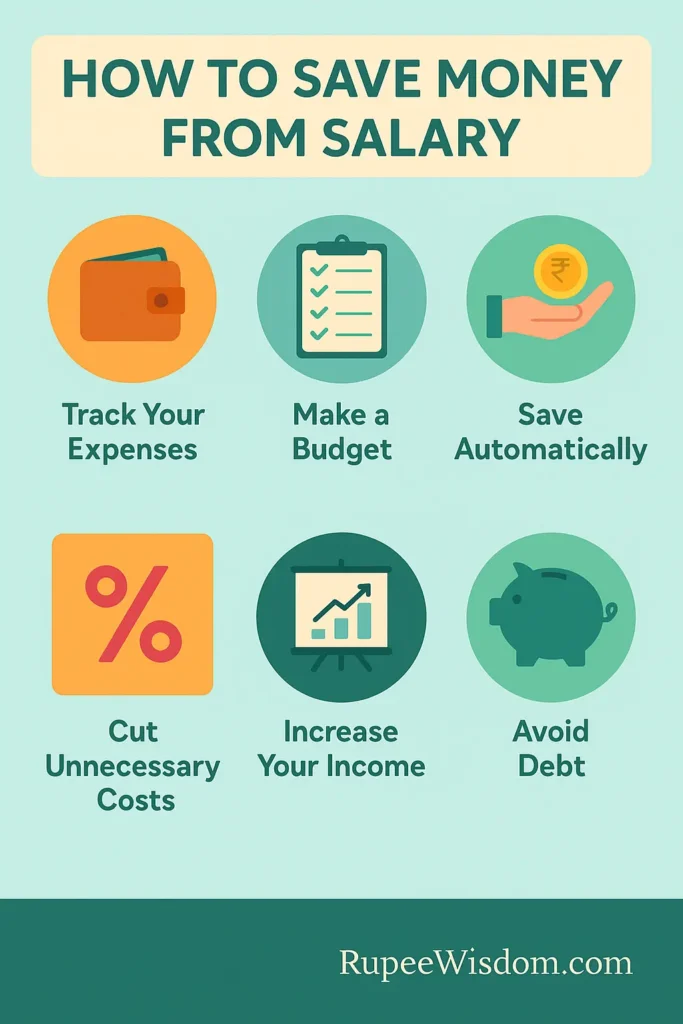
If you’ve been wondering how to save money from salary every month, this six-step Indian plan works no matter your income.
Step 1: Pay Yourself First
When your salary hits your account, don’t wait till the end of the month to see what’s left. Nothing ever will be.
Instead, pay yourself first — transfer 20–30% immediately into a savings or investment account.
Automate this transfer so saving becomes your first transaction, not your last. Treat it like rent you owe your future self.
Even ₹1,000 a month is a start — the habit matters more than the number.
What Makes Saving Money from Salary Easier in Real Life?
Saving becomes easier when you choose an amount that fits your actual expenses rather than following a target you cannot maintain.
For example, if you earn ₹30,000 a month, you could start by saving ₹1,000 as soon as your salary arrives. If you maintain that habit for a year, you will have saved ₹12,000 before interest.
Review your spending regularly. If your income rises or you find expenses you can comfortably reduce, increase your savings gradually. If an unexpected expense disrupts your plan, adjust your target and return to your routine when you can.
The aim is not to save a perfect amount every month. It is to build a savings habit that works in your real life.
Paying yourself first is the simplest and most powerful way to save money from salary consistently.
Step 2: Use the 50/30/20 Rule (Indian Edition)
This timeless method helps you organize your monthly salary clearly:
| Category | Purpose | Example (₹40,000 salary) |
|---|---|---|
| 50% | Needs (rent, food, utilities, transport) | ₹20,000 |
| 30% | Wants (shopping, eating out, OTT, travel) | ₹12,000 |
| 20% | Savings & Investments | ₹8,000 |
If your salary is small, start with 10%. It’s not about how much you save — it’s about starting now.
For irregular earners, use percentages, not fixed numbers, so you always stay on track.
Related reading
Want a practical walkthrough on turning salary into a working monthly plan? Check this guide:
How to Budget Your Salary in India — RupeeWisdomStep 3: Build an Emergency Fund Before Investing
Before you learn how to grow your money, make sure you can keep it when life throws a surprise.
An emergency fund (3–6 months of expenses) protects you from sudden shocks like job loss or hospital bills.
Keep this money in a high-interest savings account or liquid fund — somewhere safe but accessible.
Want to build your emergency fund step by step? Read our guide on How to Save for an Emergency Fund in India.
To learn more about protecting your savings, check out the RBI’s Financial Education portal — a trustworthy government resource on money management.
Without this buffer, every setback becomes debt. With it, you stay financially stable.
Step 4: Find and Fix Your “Money Leaks”
Before focusing on how to save money from salary, identify where it’s disappearing.
If you’ve been wondering “salary se paise kaise bachaen bina kisi struggle ke,” this is where you start — by simply noticing where your money actually goes.
Track your expenses for one full month — you’ll be shocked at how many silent leaks drain your account:
- Subscriptions you forgot about
- Weekend delivery orders
- Cash withdrawals without record
- Impulse shopping “because it’s on sale”
Cutting small leaks saves big over a year. Use your bank or UPI app’s expense tracker to visualize where your money goes.
Step 5: Separate Bank Accounts to Control Spending
The two-account trick is simple and effective:
- Account 1: Salary + monthly expenses
- Account 2: Savings & investments (no debit card access)
Automate a transfer from Account 1 to Account 2 right after payday.
When your savings are harder to access, you’ll naturally spend less.
If you like something tangible, keep a physical money box at home — that little gullak builds discipline faster than you’d expect.
Step 6: Invest Once the Saving Habit Is Solid
Where Should You Keep Your Savings in India?
Once your emergency fund is ready and your savings habit is strong, make your money grow.
If you’re ready to learn the basics before investing, read our guide on How to Start Investing in India.
Once your emergency savings and essential debt obligations are under control, you can consider starting a mutual fund SIP. Some funds allow small monthly investments, but choose one based on your goals, time horizon and risk tolerance.
Where Should You Keep Your Savings in India?
Choosing the right place for your savings depends on when you need the money and how much risk you can accept.
- Savings account: Suitable for money you may need at short notice. Check the interest rate, withdrawal conditions and applicable deposit protection.
- Fixed deposit (FD): Useful for planned expenses and money you can set aside for a defined period. Check premature withdrawal penalties and applicable tax.
- Recurring deposit (RD): Helps you save a fixed amount regularly, making it useful for building a disciplined savings habit.
- Liquid mutual fund: May suit some short-term cash-management needs, but returns are not guaranteed and the value can fluctuate.
- Equity mutual fund SIP: Intended for long-term investing, not emergency savings. Market-linked investments can lose value, particularly over shorter periods.
Before investing, make sure you have an accessible emergency fund and understand your existing debt obligations. Choose savings and investment options according to your financial goals, time horizon and risk tolerance.
Invest regularly and think long-term. Avoid hype-driven schemes or quick-profit traps.
For beginner-friendly financial learning, visit the National Centre for Financial Education — a government initiative that explains saving and investing in simple terms.
How Much Should You Save from Salary Each Month?
There’s no one-size-fits-all, but here’s a practical guide:
| Take-Home Salary | Recommended Saving | Why It Works |
|---|---|---|
| ₹25,000 | ₹2,500–₹3,000 (10%) | Builds the habit |
| ₹50,000 | ₹7,000–₹10,000 (15–20%) | Balanced growth |
| ₹1 lakh | ₹20,000–₹25,000+ (25%) | Accelerated wealth |
The secret isn’t the percentage — it’s consistency. A steady ₹5,000/month habit beats random bursts of ₹20,000 that never repeat.
How to Save Money from a ₹30,000 Salary Every Month
Saving money on a ₹30,000 salary can feel difficult, especially if you have rent, bills, EMIs and family responsibilities. But you don’t need to save a huge amount from day one.
If your essential expenses allow it, aim to save ₹3,000 per month, or 10% of your salary. If that feels difficult, start with a smaller amount and increase it when your budget allows.
| Monthly Salary | Savings Target | Money for Expenses |
|---|---|---|
| ₹30,000 | ₹3,000 | ₹27,000 |
That ₹3,000 would add up to ₹36,000 in a year, assuming you save it every month.
The important part is to save the money soon after receiving your salary, rather than waiting until the end of the month to see what is left.
If ₹3,000 feels difficult initially, start with ₹1,500 or ₹2,000 and gradually increase it. The goal is to build a saving habit that you can maintain every month.
As your salary increases, try increasing your savings before increasing your lifestyle expenses.
Monthly Salary Budget Examples in India: ₹20,000 to ₹1 Lakh
Knowing how much to save from your salary is only half the battle. The other half is deciding how to divide your income between household expenses, bills, personal spending and future financial goals.
Here are four illustrative monthly budget examples for different salary levels. These are starting points, not fixed rules. Your actual budget will depend on your city, rent, family responsibilities, EMIs and other essential expenses.
1. How to Manage a ₹20,000 Salary
| Expense Category | Monthly Amount |
|---|---|
| Rent and household expenses | ₹7,000 |
| Groceries and food | ₹3,500 |
| Electricity, phone and internet | ₹1,000 |
| Transport | ₹1,500 |
| Medical and other essentials | ₹2,000 |
| Personal spending | ₹2,000 |
| Savings | ₹2,000 |
| Other expenses and buffer | ₹1,000 |
| Total | ₹20,000 |
Savings target: ₹2,000 per month, or 10% of your salary.
If your essential expenses are higher, start with a smaller savings target and increase it when your financial situation improves.
2. How to Manage a ₹30,000 Salary
| Expense Category | Monthly Amount |
|---|---|
| Rent and household expenses | ₹9,000 |
| Groceries and food | ₹4,500 |
| Electricity, phone and internet | ₹1,500 |
| Transport | ₹2,000 |
| Medical and other essentials | ₹2,000 |
| Personal spending | ₹3,000 |
| Savings | ₹3,000 |
| Other expenses and buffer | ₹5,000 |
| Total | ₹30,000 |
Savings target: ₹3,000 per month, or 10% of your salary.
Review the buffer category carefully. If you regularly have money left over, transfer part of it into savings instead of allowing it to disappear into unplanned spending.
3. How to Manage a ₹50,000 Salary
| Expense Category | Monthly Amount |
|---|---|
| Rent and household expenses | ₹13,000 |
| Groceries and food | ₹6,000 |
| Utilities and phone | ₹2,000 |
| Transport | ₹3,000 |
| Medical and insurance | ₹3,000 |
| Personal spending and entertainment | ₹5,000 |
| Savings and investments | ₹10,000 |
| Other expenses and buffer | ₹8,000 |
| Total | ₹50,000 |
Savings target: ₹10,000 per month, or 20% of your salary.
If you already have an adequate emergency fund, you can allocate part of your monthly savings towards suitable long-term investments based on your goals and risk tolerance.
4. How to Manage a ₹1 Lakh Salary
| Expense Category | Monthly Amount |
|---|---|
| Rent and household expenses | ₹25,000 |
| Groceries and food | ₹10,000 |
| Utilities and phone | ₹3,000 |
| Transport | ₹5,000 |
| Medical and insurance | ₹5,000 |
| Personal spending and entertainment | ₹10,000 |
| Savings and investments | ₹25,000 |
| Other expenses and buffer | ₹17,000 |
| Total | ₹1,00,000 |
Savings target: ₹25,000 per month, or 25% of your salary.
A higher income creates an opportunity to save more, but only if your lifestyle expenses do not rise at the same pace as your earnings.
How to Choose the Right Savings Target
You do not have to follow these examples exactly. Start by listing your unavoidable expenses, including rent, groceries, EMIs, insurance and family responsibilities.
Next, set a savings target that you can maintain consistently. If you have expensive outstanding debt, balance a starter emergency reserve with a plan to reduce that debt. Once your financial foundation is stronger, increase your savings and invest according to your goals.
The most effective salary budget is not the one that looks perfect on paper. It is the one you can follow month after month.
If you want to see a complete example of how a ₹30,000 salary can be divided between different expenses and savings, read our Salary ₹30,000 Budget Example.
Common Myths About How to Save Money from Salary
Myth 1: “I’ll save once I earn more.”
Expenses can rise along with income. Start with an amount you can afford today, even if it is small.
Myth 2: “I can’t save with loans.”
Saving can be difficult when you have EMIs. Start with a realistic amount, maintain required loan payments and prioritise expensive debt according to your financial situation.
Myth 3: “Investing is risky.”
Different investments carry different levels of risk. Understand the risks, time horizon and suitability of an investment before putting your money into it.
Myth 4: “I’ll save what’s left.”
Waiting until the end of the month can make saving harder. Set aside a realistic amount when your salary arrives, then plan your spending around what remains.
How to Save Money from Salary When You Have EMIs
Saving money can feel difficult when a large part of your salary goes towards loan EMIs, rent, household expenses and family responsibilities. The solution is not to follow a savings percentage that your budget cannot support. It is to create a realistic plan around your actual income and obligations.
1. Calculate How Much Salary Is Left After Essential Expenses
Start with your monthly take-home salary. Subtract essential household expenses, necessary bills and minimum contractual loan payments.
The amount remaining tells you how much flexibility you have for savings, additional debt repayment and discretionary spending.
2. Start with a Small Emergency Reserve
If you have little or no emergency savings, consider building a modest cash reserve for unexpected expenses. Even a small amount saved regularly can reduce your dependence on borrowing when something goes wrong.
Keep this money accessible and separate from your everyday spending balance.
3. Prioritise Expensive Debt
If you have outstanding credit-card balances or other high-interest debt, compare their interest costs with the return you could reasonably expect from savings or investments.
Continue making required payments on your loans. After setting aside an appropriate emergency buffer, consider directing extra money towards the debt with the highest interest rate, while accounting for any applicable charges or repayment conditions.
4. Do Not Force Yourself to Save 20%
If your budget is tight, saving 5% or even a smaller fixed amount may be more realistic than targeting 20% immediately.
For example, on a monthly salary of ₹30,000, saving ₹1,000 consistently creates ₹12,000 in savings over a year, before any interest. Increase the amount when your income rises or expenses fall.
5. Avoid Taking New Debt to Maintain Your Lifestyle
Review subscriptions, discretionary shopping, food delivery and other non-essential expenses. The aim is to free up money without cutting necessities or neglecting important family responsibilities.
If you are already struggling to meet essential expenses and contractual repayments, focus first on understanding your cash flow and contacting your lender about available options. Do not take another high-cost loan simply to keep up with existing payments.
Remember: A sustainable financial plan balances emergency savings, debt repayment and everyday needs. Your first goal is to make your finances more stable; you can increase your savings rate as your situation improves.
Myth 3: “Investing is risky.”
→ Different investments carry different levels of risk. Understand the risk before investing, rather than assuming every investment is safe or unsafe.
Myth 4: “I’ll save what’s left.”
→ Nothing’s ever left. Save first, spend later.
Daily Habits That Strengthen Your Savings Discipline
- Review your spending every Sunday night.
- Withdraw limited weekly cash.
- Wait 24 hours before any non-essential purchase.
- Rename your savings account to your goal (e.g., “Home Fund”).
- Increase your saving rate by 1% after every salary hike.
These small habits stack up over time — quietly but powerfully.
How to Save Money from Salary When You Have a Family
If you live with a partner or family, saving becomes a team effort.
- Maintain a shared expense account for household costs.
- Divide contributions based on income proportion.
- Set joint financial goals — home, education, or vacation fund.
- Discuss money openly every month.
Couples who align their money habits grow wealth faster and fight less about finances.
How to Save Money from Salary: A 30-Day Action Plan
You can begin improving your salary habits in just 30 days. Use this four-week plan to put the steps above into practice and make your savings routine more consistent.
Week 1: Understand Your Spending
Track every expense for seven days, including UPI payments, groceries, bills and small purchases. Identify where your money goes and which expenses you can reduce without affecting essential needs.
Week 2: Set a Realistic Savings Target
Calculate your monthly take-home salary and essential expenses. Choose a savings target that fits your financial situation, even if you can initially save only ₹500 or ₹1,000 per month.
Week 3: Automate Your Savings
Arrange an automatic transfer to your savings account shortly after payday. Keep your savings separate from the account you use for everyday spending, so you are less tempted to spend the money.
Week 4: Review and Improve
Review your spending for the month. Check whether you met your savings target, identify any unexpected expenses and adjust your budget for the following month.
At the end of 30 days, continue tracking expenses and saving consistently. As your income increases or expenses decrease, gradually increase your savings target.
The goal is simple: Build a repeatable system that helps you save money from your salary every month, rather than relying on willpower alone.
External Tools & Resources for Smarter Salary Management
- RBI Financial Education Portal – Trusted lessons on saving and managing money.
- NCFE – India’s national hub for financial literacy programs.
Related Guides on RupeeWisdom
If you found this guide on how to save money from salary useful, explore more RupeeWisdom articles that help you master personal finance:
- Salary 30,000 Ka Budget Example in India – Learn a practical system to manage your expenses.
- Emergency Fund: Why It’s Your Financial Lifeline – Discover how to build a safety net that protects your peace of mind.
Frequently Asked Questions
Q: How can I save money from salary if I earn less than ₹30,000?
Start with ₹500–₹1,000 monthly. The amount is secondary — consistency is key.
Q: Should I invest or save first?
For most beginners, it makes sense to build some emergency savings before taking significant investment risk. The right balance depends on your income, expenses, debt and financial situation.
Q: How do I stop spending my salary too early?
Automate savings on payday and use separate accounts to stay disciplined.
Q: What if I have multiple EMIs?
Pay off high-interest debt first, but still save a small fixed amount to build the habit.
Conclusion: Your Salary Isn’t the Problem — the System Is
Saving money from your salary doesn’t require a high income or a perfect budget. It starts with understanding your expenses, choosing a realistic savings target and setting aside money regularly.
If you can save only ₹500 or ₹1,000 a month right now, start there. Build the habit first, then increase the amount as your financial situation improves.
Your goal isn’t to follow someone else’s savings formula. It’s to build a system that helps you meet your responsibilities today while preparing for tomorrow.