Life can get expensive very quickly.
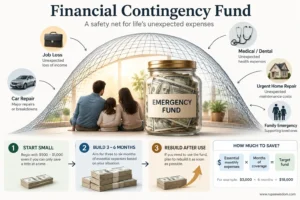
A job can disappear. A car can break down. Your furnace can stop working in the middle of winter. You can receive a medical bill you weren’t expecting, or suddenly have to travel because of a family emergency.
The problem isn’t always the expense itself. The real problem is having no money ready when the expense arrives.
A financial contingency fund is money set aside for those unexpected situations. It gives you a financial cushion so that one bad month doesn’t immediately turn into credit card debt, a personal loan, missed bills or the need to sell investments at the wrong time.
In simple terms, it is money that sits quietly in the background until life gives you a reason to use it.
This guide explains what a financial contingency fund is, how much you may need, what it should and shouldn’t cover, where to keep it, and how to build one even if you’re starting with very little.
What Is a Financial Contingency Fund?
A financial contingency fund is a dedicated pool of money reserved for unexpected and necessary expenses or a temporary loss of income.
You may also hear it called an emergency fund, rainy-day fund, or cash reserve. In personal finance, these terms are often used to describe essentially the same idea: money that is available when something goes wrong financially.
The key word is unexpected.
Your monthly rent is expected. Your annual car insurance payment is expected. Christmas gifts, a vacation and a planned home renovation are expected.
A broken water heater isn’t.
A sudden layoff isn’t.
An emergency dental bill isn’t.
That is where a financial contingency fund comes in.
The purpose isn’t to make you rich. It is to stop an unexpected event from becoming a much bigger financial problem.
Why Do You Need a Financial Contingency Fund?
Without an emergency reserve, an unexpected expense usually has to be paid from somewhere else.
You might put it on a credit card.
You might take out a personal loan.
You might borrow from family.
You might sell stocks or retirement investments.
Or you might simply delay paying another bill.
None of these options is necessarily impossible. But having cash already set aside gives you another choice.
For example, imagine your car suddenly needs a $2,000 repair and you have no savings available.
If you have a financial contingency fund with $8,000 in it, the repair is frustrating—but manageable.
If you have $200 in savings, the same repair can become a debt problem.
That is the real value of the fund.
It creates a gap between “something unexpected happened” and “my finances are now in trouble.”
What Should a Financial Contingency Fund Cover?
A good rule is to ask three questions:
- Is the expense necessary?
- Was it difficult to predict?
- Does it need to be dealt with relatively soon?
If the answer to all three is yes, the expense may qualify.
Common examples include:
Job loss or loss of income
This is one of the biggest reasons people build emergency savings.
If your paycheck suddenly stops, your mortgage or rent, utilities, groceries, insurance and other essential bills don’t automatically stop with it.
Your financial contingency fund can give you time to find another job without immediately relying on expensive debt.
Major car repairs
For many Americans, a car is necessary for getting to work, taking children to school and handling everyday responsibilities.
A major repair can therefore be more than an inconvenience.
If your transmission fails or your vehicle needs a major repair, emergency savings can help you handle the bill without putting the entire expense on a credit card.
Urgent home repairs
A leaking roof, failed furnace, broken water heater or serious plumbing problem may require immediate attention.
These are different from planned improvements.
Replacing your kitchen because you want a newer kitchen is a goal.
Fixing a serious leak before it causes more damage is an emergency.
Unexpected medical or dental expenses
Even with health insurance, you can still face deductibles, copayments and other out-of-pocket costs.
An emergency reserve can help absorb these expenses without forcing you to disrupt your regular budget.
Family emergencies
Sometimes the unexpected expense isn’t a broken appliance or medical bill.
You may suddenly need to travel to help a family member or deal with another urgent situation.
The exact circumstances will vary from household to household.
What Shouldn’t You Use It For?
This is just as important as knowing what the fund is for.
A financial contingency fund should not become your second checking account.
You generally shouldn’t use it for:
- Vacations
- Restaurant meals
- Shopping
- New electronics
- Entertainment
- Holiday spending
- A planned home renovation
- A down payment you have been saving for
- A predictable annual bill
- An investment opportunity
For example, if you know your car insurance bill is due every six months, that isn’t really an emergency. You should plan for it separately.
This distinction matters because a fund that gets spent on ordinary expenses won’t be available when a genuine emergency happens.
How Much Should You Have in a Financial Contingency Fund?
There isn’t one perfect number for everyone.
A commonly used starting point is three to six months of essential living expenses. PenFed, for example, uses three to six months as a general benchmark and emphasizes calculating the amount from essential expenses rather than discretionary spending. PenFed Credit Union
But don’t treat three or six months as a magic number.
Your ideal target depends on your income, job stability, household size, debt, insurance coverage and how quickly you could replace your income.
A simple starting framework looks like this:
| Situation | Possible Starting Target |
|---|---|
| Stable income, low expenses | 3 months |
| Typical household | 3–6 months |
| Single-income household | 6 months or more |
| Variable or commission income | 6–9 months |
| Self-employed or freelancer | 6–12 months |
| Highly uncertain income | Potentially more |
These are planning ranges, not rules.
Someone with a very stable job, low fixed expenses and strong insurance coverage may not need the same cash reserve as someone who is self-employed, has several dependents and faces irregular income.
Calculate Your Fund Using Essential Expenses
This is where many people make the calculation harder than it needs to be.
Don’t simply take your entire monthly spending and multiply it by six.
Instead, identify the expenses you would need to keep paying during a difficult period.
For example:
| Essential Monthly Expense | Amount |
|---|---|
| Rent or mortgage | $1,800 |
| Utilities | $250 |
| Groceries | $600 |
| Transportation | $350 |
| Insurance | $300 |
| Minimum debt payments | $400 |
| Phone/internet | $150 |
| Other essentials | $150 |
| Total | $4,000 |
If your essential expenses are $4,000 per month:
3 months = $12,000
6 months = $24,000
So a reasonable initial target might be somewhere between $12,000 and $24,000.
You don’t have to save $24,000 before you consider yourself financially prepared.
Building the fund is a process.
What If You Can’t Save $12,000 or $24,000 Right Now?
This is where some emergency-fund advice becomes unrealistic.
If you’re living paycheck to paycheck, telling you to immediately save six months of expenses doesn’t solve the problem.
Start with the first layer.
Your first goal could be:
$500
Then:
$1,000
Then:
$2,000
Then one month of essential expenses.
Then three months.
Eventually, you can work toward six months or more if your circumstances call for it.
The important thing is to move from having no financial buffer to having some financial buffer.
A $1,000 emergency fund won’t solve every financial crisis.
But it can handle a surprising number of smaller problems without forcing you to reach for a credit card.
How Much Should You Save If Your Income Is Irregular?
Your income matters almost as much as your expenses.
Suppose two people each spend $4,000 per month.
Person A has a stable salaried job and has worked in the same industry for ten years.
Person B is a freelancer whose income ranges from $2,500 to $8,000 depending on the month.
They don’t necessarily need the same emergency-fund target.
If your income can fluctuate significantly, a larger reserve can provide additional breathing room.
For freelancers, contractors, business owners and commission-based workers, you may want to think beyond the basic three-month target.
The goal isn’t to predict exactly when your income will fall.
It’s to make sure that if it does, you aren’t immediately forced into debt.
Where Should You Keep a Financial Contingency Fund?
The emergency fund has a different job from your investment portfolio.
Your retirement investments are designed to grow over many years.
Your emergency fund is designed to be available when something goes wrong.
That means liquidity and safety are more important than maximizing returns.
For many US households, a high-yield savings account can be a practical place to keep emergency savings because it combines relatively easy access with interest earnings.
A money market deposit account can also be suitable depending on your needs.
The key is that you should be able to access the money without taking significant market risk.
If you keep the fund in an FDIC-insured bank deposit account, eligible deposits are generally insured up to $250,000 per depositor, per insured bank, per ownership category. You can learn more about how FDIC deposit insurance works on the FDIC website. FDIC insurance applies to deposit products such as savings accounts and money market deposit accounts; it does not cover stocks, mutual funds or other investment products.
That distinction matters.
Should You Keep Your Emergency Fund in Stocks?
Generally, no.
Imagine you have $15,000 set aside for emergencies and invest the entire amount in the stock market.
Then the market falls 25% just as you lose your job.
Your $15,000 could temporarily become $11,250 at exactly the moment you need the money.
That’s the opposite of what an emergency fund is supposed to do.
Your emergency fund isn’t there to maximize your investment return.
It is there to give you financial stability when you need it.
Should You Keep It in a Certificate of Deposit?
It depends.
A CD can offer a higher rate than some ordinary savings accounts, but the trade-off is access.
Some CDs require you to leave the money untouched for a specified period or may charge an early-withdrawal penalty.
That doesn’t automatically make CDs bad.
It simply means you need to understand the access rules before putting emergency money there.
Your first priority should be making sure you can actually get to the money when an emergency occurs.
Should Your Financial Contingency Fund Be in One Account?
Not necessarily.
Some people prefer one dedicated high-yield savings account because it is simple.
Others divide their cash into layers.
For example:
- First layer: $1,000–$2,000 for immediate smaller emergencies
- Second layer: One to three months of essential expenses
- Third layer: Additional savings for longer income disruptions
There isn’t a requirement to structure it this way.
The advantage is psychological as much as financial: your everyday spending money stays separate from money that exists for emergencies.
Financial Contingency Fund vs. Emergency Fund
Are they different?
In everyday personal finance, they’re often used interchangeably.
An emergency fund is usually the more familiar term.
A financial contingency fund can be thought of as the broader idea of preparing financially for unexpected events.
For example, your overall contingency planning might include:
- Emergency savings
- Health insurance
- Auto insurance
- Homeowners or renters insurance
- Disability coverage
- Life insurance where appropriate
- A manageable debt load
- Important financial documents
- A plan for reducing expenses if income falls
The cash reserve is the most visible part of that plan, but it doesn’t have to be the only part.
A Financial Contingency Fund Is Not a Substitute for Insurance
This is an important distinction.
You shouldn’t try to save enough cash to personally cover every possible financial disaster.
That’s what insurance is partly designed to protect against.
For example, you don’t necessarily need a $500,000 emergency fund because your home could suffer $500,000 of damage.
You need appropriate homeowners insurance for major covered losses, plus enough accessible savings for deductibles, temporary expenses and smaller problems.
The same principle applies to health, auto, disability and other types of insurance.
Think of it this way:
Insurance protects you from large financial losses.
Emergency savings helps you handle the immediate financial impact.
You generally need both.
How to Build a Financial Contingency Fund Step by Step
You don’t need a complicated financial system.
Step 1: Calculate your essential monthly expenses
Write down the bills you would need to continue paying if your income stopped.
Focus on necessities, not your normal lifestyle.
Step 2: Choose your first target
If you’re starting from zero, don’t obsess over six months.
Choose a first milestone such as $500 or $1,000.
Then build from there.
Step 3: Open a separate savings account
Keeping the money separate from your everyday checking account can make it harder to spend casually.
You want the money to be accessible—but not constantly visible in your spending balance.
Step 4: Automate the transfer
Set up an automatic transfer after payday.
Even $50 per paycheck is progress.
At $100 per paycheck, you would contribute roughly $2,600 over a year if you’re paid every two weeks.
At $200 per paycheck, that becomes roughly $5,200.
The exact amount matters less than creating a system you can maintain.
Step 5: Add extra money when you receive it
A tax refund, work bonus, side-income payment or other unexpected cash can help accelerate the fund.
You don’t have to put every extra dollar into savings.
But directing a portion toward your financial contingency fund can significantly shorten the time it takes to reach your target.
Step 6: Increase the target when your life changes
Your emergency-fund target shouldn’t stay frozen forever.
Recalculate it after major changes such as:
- Buying a home
- Having a child
- Losing a second household income
- Becoming self-employed
- Taking on a large loan
- Changing jobs
- Moving to a higher-cost area
Your financial responsibilities can change substantially over a few years.
Your emergency reserve should change with them.
What If You Have Credit Card Debt?
This is where personal finance becomes less black and white.
You may have heard that you should throw every available dollar at high-interest credit card debt and keep nothing in savings.
That can make sense mathematically—but having zero cash can create another problem.
If your car breaks down and you have no emergency savings, you may simply put the repair on the same credit card you’re trying to pay off.
A better approach for many people is to build a small initial cash buffer while aggressively tackling expensive debt.
Once that initial cushion exists, you can focus more heavily on paying down high-interest debt and then build the larger emergency reserve.
The right balance depends on your income, debt interest rates and personal circumstances.
What Happens When You Use Your Emergency Fund?
Use it.
That’s what it is there for.
Some people become so obsessed with protecting their emergency fund that they hesitate to spend it even during a genuine emergency.
That’s backwards.
If your furnace breaks and you need to spend $1,500 to repair it, using your emergency savings may be exactly the right decision.
The important part comes afterward.
Rebuild the fund.
If your target was $10,000 and you use $2,000, your new balance is $8,000.
Once the emergency has passed, temporarily increase your savings contributions until the fund is restored.
Common Financial Contingency Fund Mistakes
Saving too little
Having $300 in an account and calling the job finished isn’t the same as having a properly sized emergency reserve.
Start small, but keep building.
Saving too much
The opposite can also happen.
If you’ve accumulated 18 or 24 months of ordinary living expenses in cash while carrying expensive debt or neglecting long-term financial goals, you may want to reconsider the balance.
More cash isn’t automatically better.
The goal is enough, not the biggest possible number.
Investing the money
An emergency fund should not depend on market conditions.
Keep your emergency reserve separate from money intended for long-term growth.
Keeping it in your checking account
If your emergency savings sits beside your spending money, it can be surprisingly easy to spend.
A separate account can create a useful psychological barrier.
Using it for predictable expenses
Your emergency fund shouldn’t pay for every expense that you forgot to budget for.
A bill being unpleasant doesn’t automatically make it an emergency.
Forgetting to replenish it
Using the fund is only half the process.
Rebuilding it is the other half.
A Simple Financial Contingency Fund Example
Suppose Sarah earns $6,500 per month after taxes.
Her essential monthly expenses are approximately $4,000.
She decides that six months of essential expenses is an appropriate long-term target.
Her target is therefore:
$4,000 × 6 = $24,000
But she doesn’t have $24,000 available today.
She starts with a goal of $1,000.
Once she reaches $1,000, she continues toward $5,000.
Then she works toward three months of expenses:
$4,000 × 3 = $12,000
Eventually, she reaches her six-month target of $24,000.
If she later loses her job, the fund gives her time to search for another position without immediately relying on high-interest debt.
That’s the real purpose of the money.
It’s not sitting there doing nothing.
It’s buying her time and flexibility.
How Often Should You Review Your Financial Contingency Fund?
Once or twice a year is a reasonable starting point.
You don’t need to obsess over it every week.
Review it when:
- Your income changes
- Your rent or mortgage changes
- Your family grows
- Your debt changes significantly
- Your insurance coverage changes
- Your employment situation changes
- Your essential expenses increase
Ask yourself:
“If my income stopped tomorrow, how long could I keep paying the bills without borrowing?”
That’s a much more useful question than simply asking whether your savings balance looks big.
The Bottom Line
A financial contingency fund isn’t about expecting something terrible to happen.
It’s about accepting that unexpected things happen—and preparing before they do.
Start with what you can afford.
For more personal finance guides written specifically for US readers, explore the RupeeWisdom US section.
Build your first $500 or $1,000.
Then work toward one month of essential expenses.
From there, consider three to six months as a broader target, adjusting it based on your income stability, family responsibilities and financial situation.
Keep the money accessible and separate from your everyday spending.
Don’t invest your emergency reserve simply because you want it to earn more.
And when you eventually need to use it, don’t feel like you’ve failed. That’s exactly why you built it.
A good financial contingency fund doesn’t prevent emergencies.
It prevents an emergency from becoming a financial disaster.
Frequently Asked Questions
Is a financial contingency fund the same as an emergency fund?
For personal finance, the terms are often used interchangeably. Both generally refer to money set aside to handle unexpected expenses or a temporary loss of income.
How much should I have in a financial contingency fund?
A common starting point is three to six months of essential living expenses. People with unstable income, significant dependents or higher financial uncertainty may choose a larger reserve.
Where should I keep my financial contingency fund?
A dedicated savings account, particularly a high-yield savings account, can be a practical option because the money remains accessible while earning interest. Money market deposit accounts can also be considered.
If you use a bank account, check whether the bank is FDIC-insured and understand the applicable coverage limits. The FDIC explains which types of deposits are covered and how deposit insurance limits work. Eligible deposits are generally insured up to $250,000 per depositor, per insured bank, per ownership category.
Can I invest my financial contingency fund?
Generally, emergency savings should not depend on stock-market performance. The money is intended to be available when you need it, so liquidity and stability are more important than pursuing higher investment returns.
Should I have six months of expenses saved?
Six months is a useful benchmark, but it isn’t a universal requirement. Your income stability, household responsibilities, debt and insurance coverage should influence your target.
What if I can’t afford to save three months of expenses?
Start smaller.
Saving $500 is better than having no emergency savings. Once you reach your first target, gradually increase it toward one month of expenses and eventually toward a larger reserve.
Should I use my financial contingency fund to pay off debt?
It depends on the type of debt and your circumstances. If you have high-interest debt, aggressively paying it down can be important, but having absolutely no cash reserve can leave you vulnerable to taking on more debt when an emergency occurs.
What happens if I use my emergency fund?
Use it when a genuine emergency occurs, then make rebuilding the fund a priority once the immediate problem is under control.