
Ramesh earns ₹42,000 a month.
Every month, he promises himself he’ll save at least ₹8,000.
By the 9th, he’s already overshot his food delivery budget.
By the 14th, a relative’s function appears out of nowhere.
By the 23rd, he’s using credit cards “just for now.”
By the 30th, his savings are ₹0.
Ramesh isn’t irresponsible.
He’s simply repeating the same budgeting mistakes Indians make over and over — mistakes that are so common that they feel normal.
This guide is NOT the usual theoretical budgeting advice.
This is a deep, India-specific, practical, emotionally intelligent roadmap to stop money leaks, gain control, and build financial stability — whether you earn ₹15,000 or ₹1.5 lakh.
Let’s fix your budgeting forever.
Why Budgeting Feels Hard in India (The Real Truth)
Budgeting in India is not the same as budgeting in Western countries.
We deal with:
- Family dependence
- Cultural obligations
- Festivals that demand spending
- Fluctuating incomes
- Joint households
- Social pressure
- Rising cost of living
- Unplanned medical needs
- EMIs everywhere
- UPI spending that makes money feel “not real”
Most people aren’t bad with money — they simply don’t have systems for this environment.
Let’s break down the most important budgeting mistakes Indians make, and fix each one with practical Indian solutions.
Mistake #1: Budgeting Based on Gross Salary Instead of Real In-Hand Income
If your budget starts with your CTC…
Congratulations, you’re budgeting in the Marvel Universe.
Actual budgeting must start with in-hand income after deductions, because Indian in-hand salaries vary due to:
- TDS
- PF
- Professional tax
- Variable pay
- Loans
- Salary delays
- Insurance deductions
- Occasional “HR surprises”
Most people plan on ₹40,000, but actually get ₹34,800.
That mismatch alone destroys the whole budget.
How to Fix This (The Reality Budget Method)
- Check your last 3 bank statements.
- Note the credited salary each month.
- Use the lowest as your base income.
- Create a 5–10% deduction buffer.
- Automate your savings the moment salary arrives.
To understand how to divide your take-home income into a practical monthly structure, explore this step-by-step guide on How to Budget Your Salary.
Budgeting based on expected income is the fastest way to financial chaos.
Budgeting based on real income is the foundation of stability.
Mistake #2: Treating Everything as “Essential”
This is one of the sneakiest budgeting mistakes Indians make.
We emotionally justify almost any purchase:
- “I needed a break.”
- “It was on sale.”
- “Festival season hai.”
- “Everyone is buying it.”
- “It’s small only.”
The problem?
When EVERYTHING is essential, NOTHING is controlled.
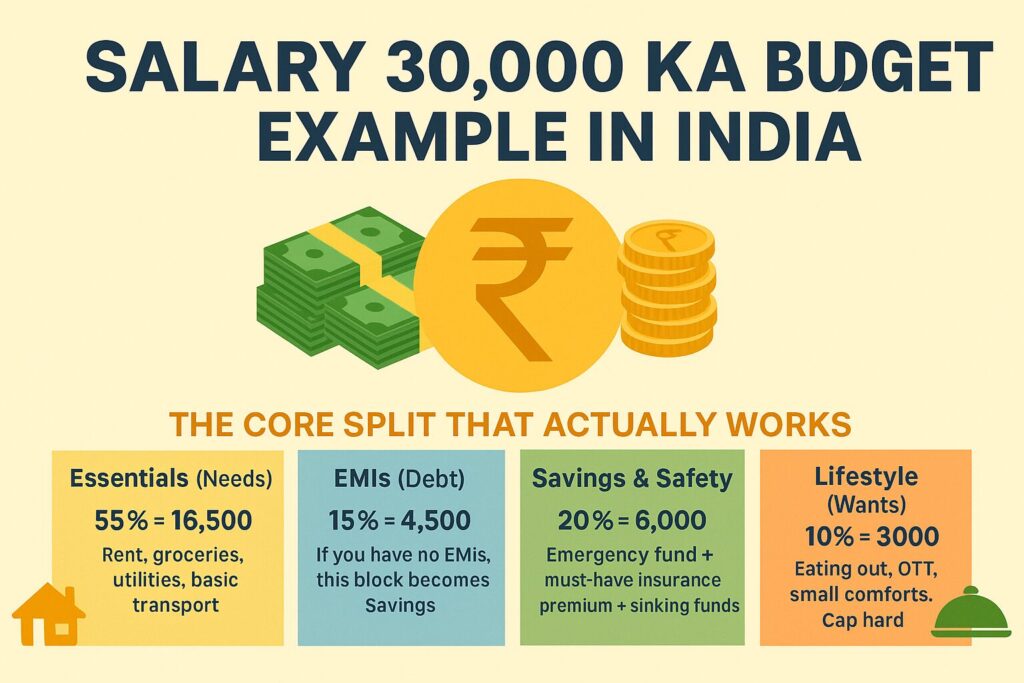
Fix: Categorise With 50/30/20 (Indian Version)
Divide your income like this:
- 50% Needs → rent, groceries, transport, utilities
- 30% Wants → eating out, entertainment, hobbies, shopping
- 20% Savings/Investments → absolutely mandatory
If your income is tight, use:
- 60/30/10
- 65/25/10
- 70/20/10
India-Specific Examples
Needs:
- Local travel
- Mobile recharge
- Groceries (which keep rising)
- School expenses
Wants:
- Food delivery
- Premium OTT subscriptions
- Online shopping
- Weekend outings
Savings:
- Emergency fund
- Recurring deposits
- SIPs
- High-yield savings backup
Categorisation transforms emotional spending into intentional spending.
For a deeper understanding of the basic principles behind spending categories, you can also check this external guide on basic principles of budgeting.Mistake #3: Forgetting Annual, Irregular & Festival Expenses
This is the MAIN reason Indians feel “money disappears suddenly.”
Irregular expenses include:
- School fees
- Annual insurance
- Festival expenses
- Home maintenance
- Medical visits
- Unexpected family events
- Travel
- Wedding gifts
- Subscription renewals
These are 100% predictable, yet they feel like shocks because they don’t occur monthly.
Fix: Create a Sinking Fund for Each Category
Take every large yearly expense → divide by 12 → save monthly.
Example Breakdown
| Expense | Yearly Cost | Monthly Amount |
|---|---|---|
| Insurance | ₹12,000 | ₹1,000 |
| School fees | ₹36,000 | ₹3,000 |
| Festivals | ₹24,000 | ₹2,000 |
| Travel | ₹18,000 | ₹1,500 |
| Repairs | ₹10,000 | ₹833 |
⭐ India-Specific Checklist
Add these sinking funds immediately:
- Diwali
- Raksha Bandhan
- Pongal / Onam / Eid
- Wedding gifts
- Annual tuition
- Vehicle servicing
- Medical buffer
- Annual home rent hike
Suddenly, nothing feels “unexpected” anymore — because you planned for it.
Mistake #4: Using Credit Cards as Backup Income
One of the most dangerous budgeting mistakes Indians make.
Credit cards feel harmless because:
- No pain at the swipe
- Minimum payment feels manageable
- Rewards give illusion of value
- Apps store your card → frictionless overspending
- EMI options trap you
But credit cards are not income.
They are debt in disguise.
Fix: The Credit-Control Framework
Do this:
- Pay FULL bill monthly
- Delete saved cards from apps
- Track credit spending weekly
- Set a strict monthly limit
- Avoid EMIs for wants
- Avoid Pay-Later and BNPL apps
India-Specific triggers to avoid:
- Festival offers
- Bank discount traps
- “Zero-cost EMI” temptation
- Swiping at restaurants without thinking
- Using credit for gifting obligations
Credit cards are either your best friend or your silent enemy — depending on how you use them.
To understand the real cost of delaying payments, here’s a practical guide on Missed Credit Card Payment Consequences.Mistake #5: No Emergency Fund — The Root of Most Financial Stress
This is one of the most common budgeting mistakes Indians make — and the costliest.
One unexpected event can wipe out years of savings.
Examples:
- Hospitalisation
- Job loss
- Family emergencies
- Urgent travel
- Appliance breakdowns
- Vehicle repair
Without a buffer, families fall into:
- Loan dependency
- Credit card debt
- Borrowing
- Emotional stress
Fix: Build a 3–6 Month Emergency Fund
Start with:
- ₹500/month
- Then ₹1,000
- Then ₹2,000
Store it in:
- Liquid account
- Sweep-in FD
- Anything accessible quickly
This one step reduces financial anxiety more than any other.
To understand the safest and most practical places to keep your emergency savings, here’s a detailed guide on Where to Park Emergency Fund.Mistake #6: Not Tracking Expenses (Budgeting Blindfolded)
People who don’t track expenses think they’re doing fine… until they actually check.
Typical Indian scenario:
- “I think I spent only ₹3,000 eating out.”
- Actual: ₹11,200
Most budgets fail not because of big expenses, but because of tiny daily ones.
Once you start tracking and seeing where your money actually goes, you’ll naturally look for practical ways to save more—here’s a simple guide on How to Save Money from Salary.Fix: Weekly Review Ritual (10 Minutes)
Every Sunday:
- Check your UPI history
- Check bank transactions
- Check credit card usage
- Categorise everything
- Identify overspending
- Fix next week’s limits
Weekly tracking is realistic, sustainable, and extremely effective.
Mistake #7: Budgeting Alone While Family Spends Without Alignment
Indian households are collective units.
If one person budgets alone while others spend randomly — the budget collapses.
This is a major budgeting mistake Indians make.
Fix: The Monthly Family Money Meeting (10 Minutes)
Discuss:
- Bills
- Upcoming expenses
- Savings
- Sinking funds
- Household goals
- Lifestyle adjustments
This builds shared responsibility and reduces financial conflicts.
To set up your sinking funds smoothly, it helps to start with a strong monthly plan—here’s a simple guide on How to Make a Monthly Budget in India.Mistake #8: Lifestyle Inflation — The Silent Budget Killer
You get a raise → you upgrade lifestyle.
Instantly.
This is one of the most damaging budgeting mistakes Indians make.
Examples:
- New phone because salary increased
- More frequent dining out
- Upgraded clothing brands
- Costlier rent
- More travel
- Higher “treat yourself” spending
But raises should first increase savings, not spending.
Fix: Compensation Upgrade Rule
When salary increases:
- Increase your savings automatically
- Keep lifestyle same for 3–6 months
- Upgrade selectively, not impulsively
Lifestyle inflation destroys wealth quietly.
Stopping it creates wealth quietly.
Mistake #9: Ignoring Small Recurring Expenses
Small expenses are silent killers — ₹50, ₹100, ₹199, ₹349…
Monthly subscriptions, app renewals, small deliveries, upgrades — they add up to thousands.
Fix: The Subscription Audit
Every 90 days:
- List all subscriptions
- Cancel unused ones
- Cap subscriptions at a fixed monthly limit
- Track renewals
- Disable auto-renew where possible
Your budget becomes instantly cleaner.
Mistake #10: Expecting Budgeting Alone to Fix Everything
Budgeting can fix overspending —
it cannot fix low income, debt, or lack of skill growth.
This is one of the most misunderstood budgeting mistakes Indians make.
Fix: Two-Engine Money Strategy
Engine 1 — Control Expenses
Budgeting, tracking, sinking funds, emergency fund.
Engine 2 — Increase Income
Upskill, switch roles, freelancing, side income.
A stable financial life needs both.
If you’re new to the concept and want a simple starter explanation, here’s a clear guide on What Is an Emergency Fund?.BONUS: Common Indian Financial Triggers
These unique Indian triggers cause budgets to break:
- Festival pressure
- Social comparison
- Family obligations
- Weddings
- Gifting expectations
- Salary delays
- Medical surprises
- School-related expenses
- Emotion-driven shopping
Knowing your triggers reduces your spending dramatically.
When your budgeting becomes stable and consistent, long-term goals like early financial freedom become realistic—here’s a clear guide on How to Retire Early in India.Why You Must Fix Budgeting NOW (Not Later)
Every month you delay budgeting, you lose:
- Peace of mind
- Compounding power
- Savings growth
- Emergency protection
- Financial confidence
One disciplined year can change your next 30 years.
Ultimate Indian Budgeting System (The 10-Step Action Plan)
This is the ONLY system you need:
1. Calculate your real in-hand income
Not assumptions.
2. Track the last 30 days honestly
No hiding, no excuses.
3. Categorise expenses using 50/30/20 (or your custom ratio)
4. Set fixed limits for each category
Hard numbers, not guesswork.
5. Create sinking funds for irregular expenses
6. Automate savings the moment salary arrives
7. Build a 3–6 month emergency fund
8. Run a weekly 10-minute tracking ritual
9. Do a monthly family budget review
10. Control lifestyle inflation consciously
Do this for 90 days — your financial life will transform.
Conclusion
The biggest truth about budgeting mistakes Indians make is this:
You don’t fix money by earning more.
You fix money by managing better.
This guide gave you:
- Clarity
- Structure
- Psychology
- Indian examples
- Deep solutions
- Real systems
- Long-term stability
Apply the steps, follow the system, and you’ll never fear your bank balance again.
Budgeting isn’t restriction.
Budgeting is freedom — with direction.