
If you are searching for how to send money from credit card to bank account, you are likely facing one of three situations:
- You need emergency funds.
- Your bank balance is low.
- You want to temporarily manage cash flow.
Yes, in India, it is possible to send money from a credit card to a bank account. But before you do it, you must understand something critical:
This is not a normal transaction.
It is treated as a cash advance.
And cash advances are expensive.
As someone who has worked closely with borrowers dealing with credit card stress, I can tell you this — most people use this facility without fully understanding the long-term cost.
This guide will explain:
- All legal methods available in India
- Step-by-step process
- Exact charges involved
- Interest impact
- Credit score effect
- When you should use it
- When you absolutely should not
Let’s break down how to send money from credit card to bank account the right way.
What Does It Mean How to Send Money From Credit Card to Bank Account?
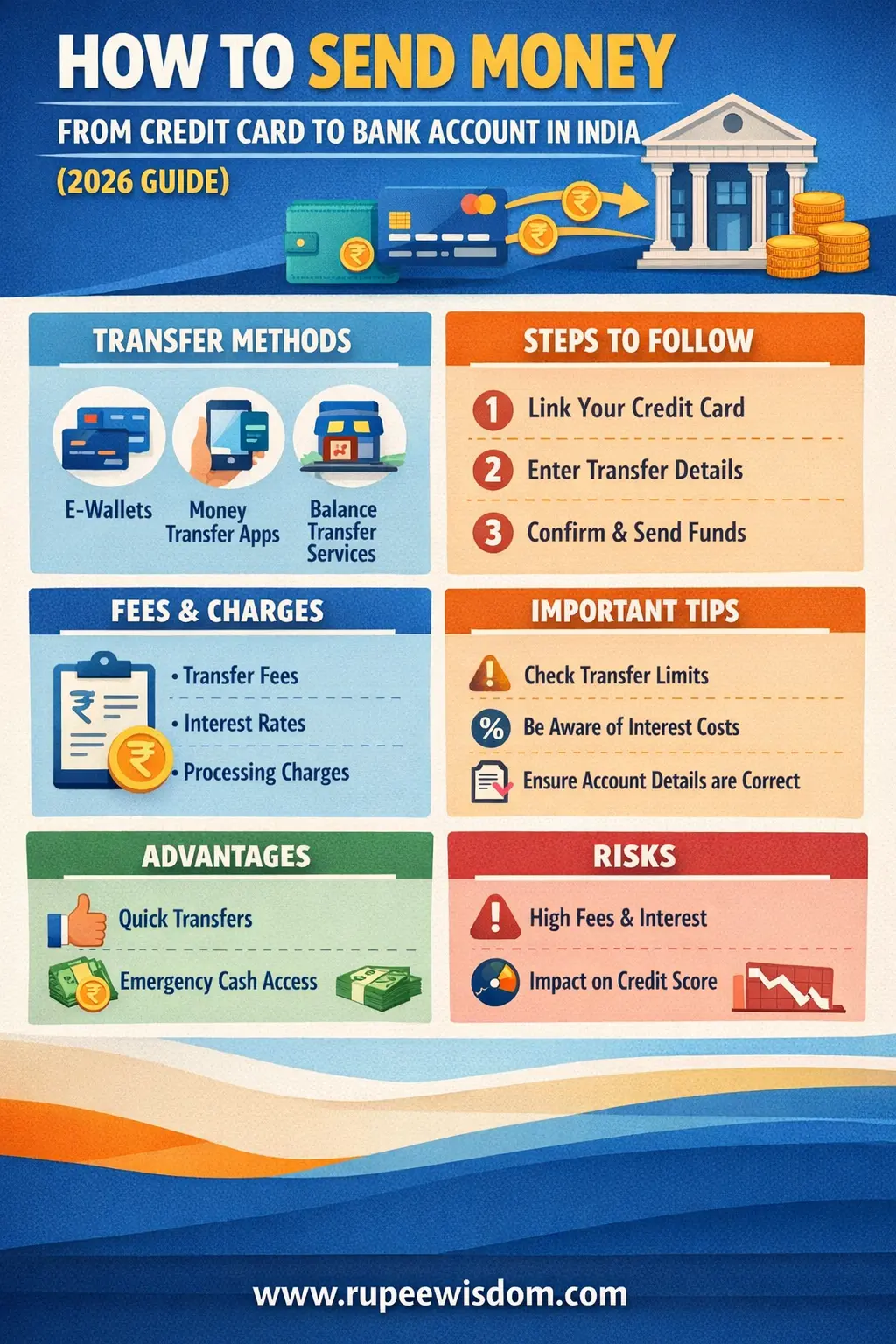
Complete 2026 guide to transferring money from credit card to bank account in India.
When you send money from credit card to bank account, you are converting your available credit limit into cash.
Banks treat this as:
- Cash advance
- Short-term borrowing
- High-risk transaction
Unlike regular card purchases, there is:
- No interest-free period
- Immediate interest calculation
- Additional processing fees
So while technically you can send money from credit card to bank account, financially it behaves very differently from swiping your card at a store.
5 Legal Ways on How to Send Money From Credit Card to Bank Account in India
There are five commonly used methods in India.
1. Direct Bank Transfer (If Offered by Your Bank)
Some banks allow you to send money from credit card to bank account directly through net banking.
Steps:
- Log in to net banking.
- Go to credit card section.
- Select “Transfer to Bank” or “Cash Advance.”
- Enter amount.
- Confirm transaction.
Not all banks provide this feature.
Important:
This is still treated as a cash advance.
2. ATM Cash Withdrawal + Deposit
This is the most traditional method to send money from credit card to bank account.
Process:
- Visit ATM.
- Insert credit card.
- Select cash withdrawal.
- Enter PIN.
- Withdraw money.
- Deposit cash into your bank account.
Charges Typically Include:
- 2%–3.5% cash advance fee
- Minimum ₹300–₹500 charge
- Interest from day one
- Higher interest rate than purchases
This method works instantly — but it is one of the most expensive ways to send money from credit card to bank account.
3. Credit Card Cheque (Balance Transfer Cheque)
Some issuers provide cheque facilities.
You can:
- Write cheque to yourself
- Deposit into bank account
- Funds get credited after clearing
Again, this is treated as borrowing. Interest and fees apply.
4. Wallet Apps (Paytm, MobiKwik, etc.)
Another way people generally opt for as to how to send money from credit card to bank account is through wallet loading.
How it works:
- Add money to wallet using credit card.
- Transfer wallet balance to bank account.
Hidden Reality:
- Wallet loading fee
- Processing fee
- Interest from issuer side
- Possible cash advance classification
It feels convenient. It is not free.
5. UPI Linked Credit Card (Indirect Alternative)
If your goal is spending — not cash transfer — you can link RuPay credit card to UPI apps and pay merchants directly.
But this does not truly send money from credit card to bank account. It only allows spending via credit.
Charges Involved When You Send Money From Credit Card to Bank Account
Let’s understand the cost clearly.
1. Cash Advance Fee
Usually 2%–3.5%.
Example:
₹50,000 transfer
3% fee = ₹1,500 instantly charged.
2. Interest From Day One
Interest may range 30%–48% annually.
If monthly interest is 3.5%:
₹50,000 → ₹1,750 interest per month.
3. GST on Fees
18% GST applies on processing fee.
4. Credit Utilisation Impact
If your limit is ₹1,00,000 and you send ₹70,000 from credit card to bank account, your utilisation becomes 70%.
High utilisation can reduce your credit score.
Real Cost Example of Sending Money From Credit Card to Bank Account
Let’s say you transfer ₹1,00,000.
- 3% processing fee = ₹3,000
- GST on fee = ₹540
- Immediate cost = ₹3,540
If you repay after 30 days at 3.5% monthly interest:
- Interest ≈ ₹3,500
Total cost ≈ ₹7,000+
That’s around 7% cost for one month.
This is why blindly choosing to send money from credit card to bank account can become expensive.
Should You Send Money From Credit Card to Bank Account?
Based on years of observing borrower behavior, here’s practical advice.
Consider it ONLY if:
- Medical emergency
- Salary arriving in few days
- Short-term liquidity issue
- Clear repayment plan exists
Avoid it if:
- You are covering lifestyle expenses
- You already carry high credit card debt
- You have no repayment strategy
- You are emotionally stressed about money
Using this facility repeatedly often leads to a debt spiral.
What Most Articles Don’t Tell You
Most articles just show you how to send money from credit card to bank account.
Very few explain the behavioral risk.
In my experience working with borrowers:
- Many start with one transfer.
- They delay repayment.
- Interest compounds.
- Minimum due trap begins.
- Within months, they struggle.
Credit cards are powerful tools.
But using them for cash extraction repeatedly increases financial pressure.
Financial discipline matters more than convenience.
Better Alternatives Before You Send Money From Credit Card to Bank Account
Before making the decision, consider:
- Short-term overdraft facility
- Negotiating payment deadline
- Small personal loan (often cheaper)
- Borrowing temporarily from trusted family
- Selling unused assets
In many cases, alternatives cost less than sending money from credit card to bank account.
📌 You Might Also Like These Guides
Frequently Asked Questions
Can I legally send money from credit card to bank account in India?
Yes, through ATM withdrawal, net banking transfer (if available), cheque facility, or wallet apps.
Is there any free way to send money from credit card to bank account?
No. Every method includes either processing fee or interest.
Does sending money from credit card to bank account affect CIBIL score?
Yes. High credit utilisation can reduce your score if repayment is delayed.
Which app allows sending money from credit card to bank account?
Wallet apps allow wallet loading using credit card and transfer to bank account.
Is ATM withdrawal cheaper than wallet transfer?
Both are costly. Cost difference is minor compared to interest imp
Final Verdict on How to Send Money From Credit Card to Bank Account
Yes, you can send money from credit card to bank account in India.
But financially?
It should be a short-term emergency tool — not a routine habit.
If you use it:
- Calculate total cost.
- Repay quickly.
- Avoid repeated transfers.
- Monitor credit utilisation.
So, now even when you know how to send money from credit card to Bank account, you must always remember that convenience today should not become financial stress tomorrow.