
If EMIs have hijacked your salary and your savings account looks like a desert, you’re not alone. Most Indians struggle to balance loan payments, bills, and dreams of saving for the future.
Here’s the truth: you don’t need to be debt-free to start saving. You just need a smarter system.
This guide shows you how to save money for the future even while you’re in debt — step by step, the Indian way.
No complicated math, no financial jargon. Just real talk, actionable steps, and results that actually stick.
Why Learning How to Save Money for the Future Is Non-Negotiable
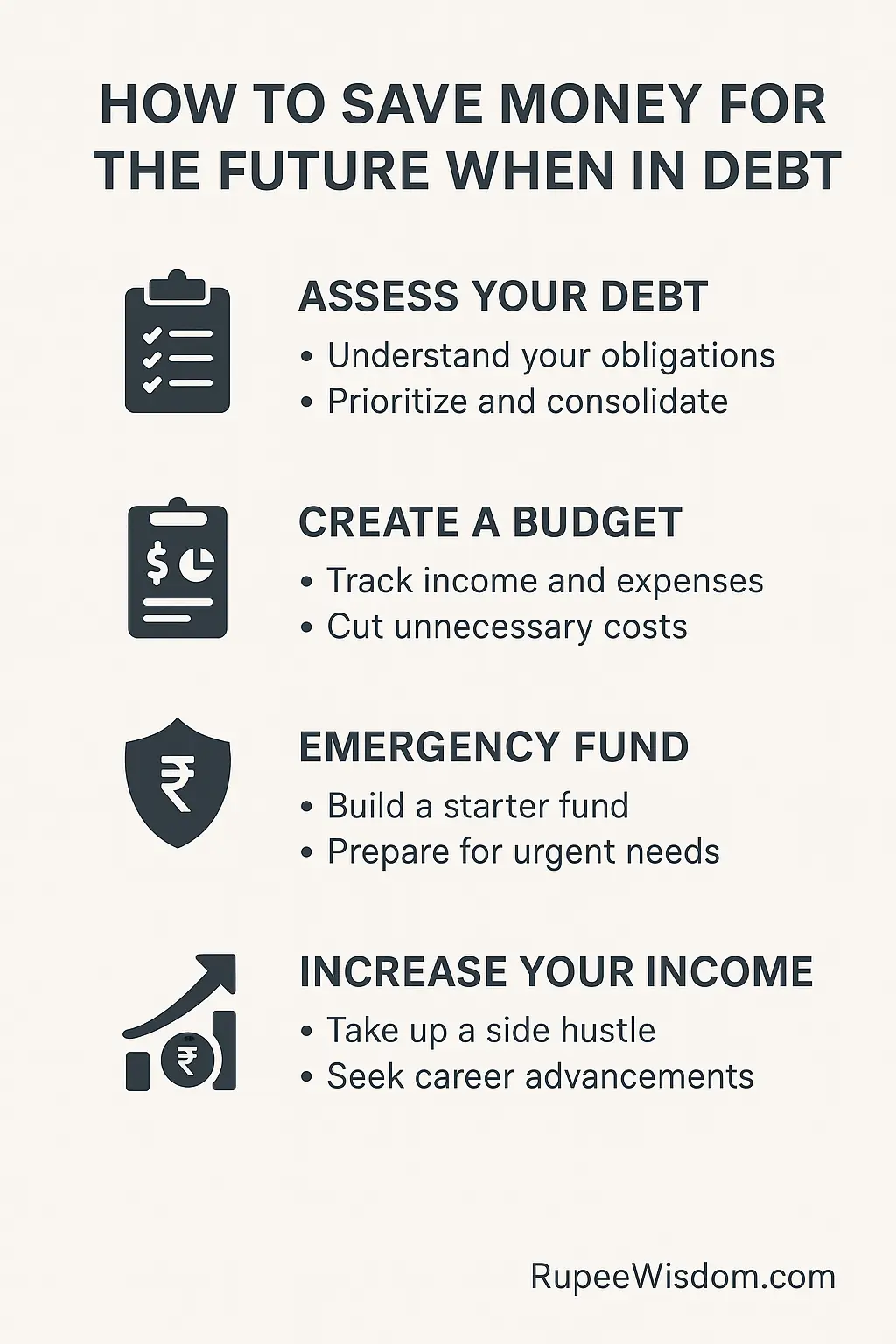
Infographic: How to Save Money for the Future When You’re in Debt — RupeeWisdom.com
It’s easy to think, “I’ll save once my loans are cleared.”
But that thinking traps you forever. Life won’t wait — medical bills, job shifts, and emergencies can strike anytime.
If you never start saving, you’ll keep borrowing. If you ignore debt, interest will swallow your future.
That’s why you must learn how to save money for the future while managing debt — so you can build stability and still make progress toward your goals.
The magic lies in balance.
Step 1: Get Real About Where You Stand
Before you decide how to save for the future, find out where your money is actually going.
- List every debt. Include credit cards, personal loans, home or car EMIs, even money borrowed from relatives.
- Note details. Balance, interest rate, EMI amount, remaining tenure.
- Add your fixed costs. Rent, groceries, transport, school fees, utilities.
- See what’s left. This leftover is your power zone — the money you’ll split between debt reduction and future savings.
Knowing the real numbers removes fear.
Step 2: Build a Small Emergency Fund First
Your first step toward learning how to save money for the future isn’t investing — it’s protection.
Start an emergency fund. Aim for ₹20,000–₹30,000 to cover basics like rent or groceries for one month.
Use a separate high-interest savings account or short-term FD. Even ₹500 a week adds up.
When emergencies happen, this fund keeps you from taking new loans. That’s how true future savings begin.
Why Saving Is Non-Negotiable — Even When Experts Say “Don’t Save Until You’re Debt-Free
Many so-called financial gurus preach, “Pay off all loans before you even think of saving.”
Nice theory. But they’re not the ones getting EMI-bounce alerts or court notices.
Let’s get practical.
If you have zero savings while you’re in debt, you’re walking a tightrope over fire.
Because when life strikes — and it will — you’ll have nowhere to turn except more debt.
Think about what happens in real Indian situations:
- A second lender files a recovery suit while you’re still repaying the first one.
- You get hit with a cheque-bounce or EMI-default case and need money for a lawyer, bail, or court costs.
- A family member falls ill right when you’re trying to clear your last instalment.
Who will fund that? The same lenders who are already chasing you? Not a chance.
That’s why building a starter emergency fund is not optional — it’s survival.
Start with something realistic:
- ₹10,000 to ₹25,000 tucked away in a separate account or short-term FD.
- This money is not for investments or luxuries. It’s purely for “break-glass” emergencies.
- Even if you’re repaying loans, set aside a tiny fixed amount monthly until you hit that goal.
This small cushion is what keeps you from sliding from “debt trouble” into “legal disaster.”
Remember: saving while in debt isn’t greed — it’s defense.
You’re not saving to grow your wealth; you’re saving to protect your sanity, your dignity, and sometimes your freedom.
So the next time someone says, “Don’t save until you’re debt-free,” smile politely and keep building your buffer.
Because only someone who’s faced a collection call or legal notice knows:
No savings means no options.
💡 Want to learn more about building an Emergency Fund?
Step 3: Automate Your Saving Habit
Saving manually never works — because human temptation wins.
Automate it.
- Set a standing instruction for 5–10 % of your income to move into your “Future Fund” right after salary credit.
- Do it before paying EMIs or bills.
- Even ₹1,000 a month counts.
That small act rewires your mindset from spender to saver. And it’s the simplest way to save money for future goals without thinking about it.
Step 4: Balance Debt Payments and Future Savings
Should you pay off debt first or save first? The answer: both — smartly.
Use this ratio as a guide:
| Stage | Debt Repayment | Future Savings | Lifestyle |
|---|---|---|---|
| Heavy debt | 70 % | 20 % | 10 % |
| Moderate debt | 60 % | 30 % | 10 % |
| Low debt | 50 % | 40 % | 10 % |
This keeps you emotionally motivated — because you’re not just clearing the past, you’re funding the future.
It’s one of the most sustainable ways to save money for the future while in debt.
Step 5: Streamline and Simplify Your Debt
Too many small loans feel suffocating. Simplify them.
- Pay at least the minimum EMI on every loan to protect your credit score.
- Attack the highest-interest one first (usually credit cards).
- Avoid new EMIs until you close one old account.
- Negotiate with lenders for rate reductions or longer tenure.
Every time you close a loan, redirect that EMI straight into your savings. That’s how your future fund snowballs fast.
Step 6: Plug Lifestyle Leaks
You can’t learn how to save money for the future without fixing the leaks that drain your wallet.
Check your last three months of expenses. Be ruthless.
- Cancel unused OTT subscriptions.
- Reduce eating out by half.
- Buy groceries in bulk once a month.
- Budget for festivals — don’t swipe emotionally.
Cutting ₹2,000–₹3,000 monthly is the same as earning ₹24,000–₹36,000 extra per year.
That’s real, tax-free income — redirected toward your future.
Step 7: Choose Simple, Safe Saving Options
When you’re managing debt, stability matters more than high returns.
Top options in India to save money for the future safely:
- Recurring Deposits (RDs): Ideal for monthly savings habits.
- Short-term FDs: Great for lump sums with guaranteed returns.
- Liquid Mutual Funds: Low risk, better than a savings account once your debt load drops.
- PPF: Perfect for long-term future goals like retirement or child education.
Avoid risky investments until you’re confident your debts are under control.
Step 8: Use Bonuses and Windfalls Smartly
That bonus, tax refund, or festival gift? Use the 50-30-20 rule:
- 50 % to clear debt faster
- 30 % to add to future savings
- 20 % to enjoy guilt-free
It’s balanced, realistic, and keeps you motivated.
A simple rule, but incredibly effective for people learning how to save money for the future without feeling deprived.
Step 9: Set Micro Goals and Celebrate Wins
Long-term goals like “retirement” feel too far away. Instead, start with micro goals:
- Save ₹10,000 in 3 months
- Build ₹50,000 in 1 year
- Close one credit card account
Small wins release dopamine. They make saving exciting. Each milestone is proof that you can build a better future, one step at a time.
Step 10: Review Your Progress Every Month
Pick one day a month — say the first Sunday — to review your numbers:
- Current debt balance
- Total savings
- Where money leaked
If you’ve reduced debt or grown savings, treat yourself modestly — maybe a movie or dinner. Reward fuels repetition.
Tracking is how average savers become consistent wealth builders.
Real-Life Story: How One Indian Saved for the Future While in Debt
Take Arjun, a 29-year-old marketing professional in Delhi. He owed ₹3 lakhs in credit cards and ₹2 lakhs in a personal loan. Salary: ₹58,000/month.
Instead of waiting to be debt-free, he started applying these steps.
- Automated ₹2,000/month into a separate “Future Fund.”
- Focused bonuses on clearing high-interest cards.
- Cut weekend spending and subscriptions.
Two years later, Arjun is debt-free with ₹1.6 lakhs saved in his RD and liquid fund.
His secret? He learned how to save money for the future while paying off the past.
That’s not magic. That’s consistency.
Mindset Shifts That Make Saving Stick
You can’t master financial skills without mastering your headspace.
“I’ll save after I’m debt-free.”
Wrong. Start now. Waiting kills momentum.
“My EMIs are too high to save.”
Then start with ₹200. It’s about habit, not amount.
“What’s the point when interest eats everything?”
Because the point is control. Savings reduce anxiety and stop impulsive borrowing.
Each small deposit is a confidence deposit, too.
Family, Culture, and Real-World India
Let’s be honest — saving money for the future in India isn’t just math; it’s emotion.
Relatives expect wedding gifts. Festivals come every month. Parents depend on us.
You can still manage it:
- Set festival budgets in advance.
- Talk openly with family about your debt plan.
- Choose thoughtful, affordable gifts over expensive ones.
You’re not being “cheap.” You’re being strategic — and that’s what builds wealth over time.
When to Seek Financial Help
Sometimes the numbers just don’t add up — EMIs exceed 60 % of income, collection calls begin, or anxiety takes over.
That’s your signal to get professional advice.
Financial counsellors and debt consultants can help you:
- Negotiate interest reductions
- Consolidate multiple loans
- Create a workable payoff schedule
Once your outflow stabilizes, you can restart your future savings plan confidently.
Getting help isn’t failure — it’s smart financial maturity.
🔗 Recommended Read: Visit the Reserve Bank of India (RBI) official website for the latest guidelines on personal loans and debt management.
Extra Tips to Save Money for Future Goals
- Increase income streams: Freelance, teach online, sell old stuff.
- Use cashback apps: For groceries and utilities — free money adds up.
- Review insurance: Overpaying on policies? Adjust to free up cash.
- Start SIPs later: Once debt is manageable, move part of your savings to SIPs for compounding growth.
- Stay motivated: Follow finance blogs or YouTube channels weekly.
These small actions, done consistently, create big results.
Quick Recap: How to Save Money for the Future
- Get clear on income, expenses, and debt.
- Build an emergency fund first.
- Automate savings.
- Use ratios to balance debt and saving.
- Simplify loans.
- Plug lifestyle leaks.
- Pick safe Indian saving tools.
- Use windfalls wisely.
- Track progress monthly.
- Stay consistent and patient.
You now know how to save money for the future — even with EMIs chasing you.
Conclusion
Debt doesn’t mean you can’t dream big. It just means your journey starts from a different point.
The smartest Indians aren’t the ones with the highest income — they’re the ones who learned early how to save money for the future while still in debt.
Start today. Automate ₹500 into your future fund. Build your buffer. Pay your dues smartly.
Over time, the numbers change — and so does your mindset.
Because financial peace doesn’t come from zero debt — it comes from positive direction.
So don’t wait for “someday.”
Start this week.
Your future self will thank you — and your bank balance will finally agree.