
If you’ve ever caught yourself wondering, “Can I really retire early in India?”, you’re not alone. The dream of financial freedom before 50 isn’t limited to Silicon Valley engineers anymore — thousands of Indians are using an Early Retirement Calculator to find out how much is enough and how to get there faster.
This guide cuts the noise. You’ll learn how to use the calculator smartly, avoid rookie mistakes, and create a real-world plan that works in India’s inflation-driven economy.
Why Early Retirement Is the New Ambition in India
Just a decade ago, “retiring early” sounded like fantasy. But the rise of remote work, financial awareness, and FIRE (Financial Independence, Retire Early) movements have changed the mindset.
Today, mid-career professionals in India — especially in tech, finance, and self-employment — aim for financial independence by 45–50. Not necessarily to stop working, but to stop needing to work.
That’s where the Early Retirement Calculator becomes your most valuable tool.
Why You Need an Early Retirement Calculator in India for Financial Freedom
1. It Turns Guesswork Into a Real Plan
The calculator helps you determine:
- The total corpus you’ll need to live comfortably post-retirement.
- How inflation will impact your expenses over time.
- How much to invest monthly to reach your target.
- The timeline to achieve true financial independence.
2. It’s Built for Indian Financial Reality
Western tools often assume low inflation, stable interest rates, and government pensions. India is a different game:
- Average inflation hovers between 5–7 %.
- Equity returns average 10–12 % long term.
- Medical costs inflate faster than normal goods.
- Many families continue to support dependents even after retirement.
That’s why an India-specific early retirement calculator gives you relevant numbers, not foreign fantasy.
Understanding the Core of an Early Retirement Calculator
Before you start punching numbers, understand how these tools work. It’s not magic — it’s compounding math simplified for humans.
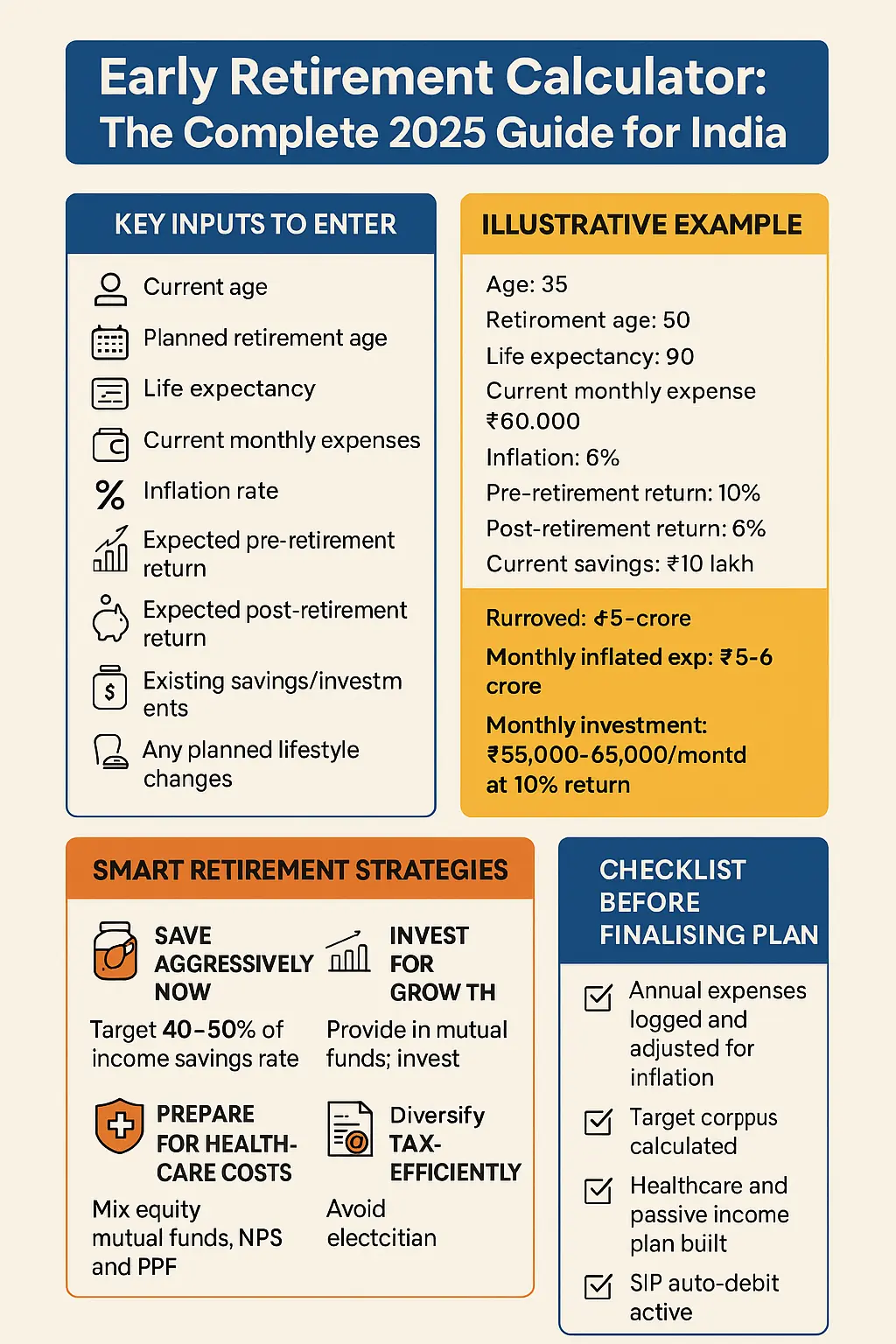
Key Inputs You’ll Need
- Current age
- Planned retirement age (for early retirement, 45–55 is typical)
- Life expectancy (assume 85–90 years)
- Current monthly expenses
- Inflation rate (5–7 %)
- Expected pre-retirement return (9–12 %)
- Expected post-retirement return (5–7 %)
- Existing savings/investments
- Any planned lifestyle changes
What the Calculator Actually Does
- It inflates your current expenses to estimate what they’ll be at retirement.
- It calculates how much you’ll need every year to cover those expenses for 30–40 years.
- It adjusts for expected returns and withdrawal rate to give you a target corpus.
- It reverse-calculates how much you must save each month to reach that goal.
Example: How the Early Retirement Calculator Works
Let’s take a realistic Indian example.
- Age: 35
- Retirement age: 50
- Life expectancy: 90
- Current monthly expense: ₹60,000
- Inflation: 6 %
- Pre-retirement return: 10 %
- Post-retirement return: 6 %
- Current savings: ₹10 lakh
By age 50, ₹60,000 will inflate to roughly ₹1.4 lakh/month. That’s ₹17 lakh/year at retirement.
Assuming a 4 % safe withdrawal rate, your required corpus = ₹17 lakh ÷ 0.04 = ₹4.25 crore.
Add a buffer for lifestyle and healthcare — target ₹5–₹6 crore.
Your existing ₹10 lakh will grow to ~₹40 lakh in 15 years.
You’ll still need to build ₹4.6–₹5 crore, which means investing ₹55,000–₹65,000/month at 10 % return.
That’s how simple — and powerful — the calculator is.
Step-by-Step: Build Your Early Retirement Plan
Step 1: Define “Early” for You
For some, early means 50. For others, 45. The earlier you want to exit, the higher the savings pressure.
Step 2: Track Your Real Expenses
Be brutally honest. Include rent/loan, groceries, transport, travel, healthcare, insurance, leisure, and education. Multiply your monthly total × 12 to get annual expense.
Step 3: Account for Inflation
Use a conservative 6 %. At that rate, prices double every 12 years. Your ₹1 lakh lifestyle today could need ₹2 lakh when you retire early.
Step 4: Estimate Investment Returns
- Pre-retirement (growth phase): 9–12 % realistic with equity mutual funds and NPS.
- Post-retirement (withdrawal phase): 5–7 % conservative mix of debt and balanced funds.
As per long-term market data, India’s average inflation rate has hovered between 5%–7% over the last decade, according to Trading Economics.
Step 5: Enter Data into the Calculator
Input your values — age, expense, inflation, returns, life expectancy. You’ll instantly see:
- Corpus required
- Current shortfall
- Monthly SIP/investment needed
Step 6: Review Annually
Adjust for income changes, inflation, or lifestyle upgrades. Treat the calculator as your yearly financial health check.
For official information on retirement planning and pension options in India, you can visit the National Pension System (NPS) website — a government-managed platform for long-term savings.
Smart India-Specific Retirement Strategies
1. Save Aggressively Now
Early retirement compresses your saving window.
Target 40–50 % of income savings rate. Use automatic SIPs to stay consistent.
Before diving into complex planning tools, it’s crucial to build a strong savings habit. Check out our guide on how to save money for the future to learn proven ways to start building wealth even before you use an Early Retirement Calculator.
2. Invest for Growth, Not Just Safety
Equities beat inflation over the long term.
Start with high-equity allocation (70–80 %), then slowly reduce risk five years before retirement.
3. Diversify Tax-Efficiently
Mix:
- Equity mutual funds for growth
- NPS and PPF for tax savings
- Debt funds and FDs for stability
- Real estate or REITs for diversification
4. Prepare for Healthcare Inflation
Set up a dedicated medical corpus (separate from main retirement fund).
Buy long-term health insurance while you’re still employed — premiums are far lower now than post-retirement.
5. Build Passive Income Streams
You don’t have to stop earning entirely.
Consider:
- Rental income
- Dividends or interest income
- Consulting/freelance work
- Small online business
Even ₹25,000/month post-retirement reduces your required corpus by lakhs.
6. Avoid Lifestyle Creep
As income rises, don’t inflate your expenses. Channel every increment into investments.
7. Rebalance Every Year
Markets shift — rebalancing protects your gains and ensures risk is aligned with your goal.
Sample Early Retirement Scenarios
Case 1: Mid-Career Manager (Age 40)
- Expense: ₹1.2 lakh/month
- Retirement age: 55
- Savings: ₹50 lakh
- Inflation: 6 %
- Life expectancy: 90
At 55, expenses ≈ ₹2.8 lakh/month → annual ₹33 lakh.
Corpus needed: ₹8–₹9 crore.
Current ₹50 lakh grows to ~₹2 crore. Needs additional ₹6–₹7 crore → invest ₹2.5–₹3 lakh/month for 15 years.
Case 2: 30-Year-Old Professional
- Expense: ₹60,000/month
- Retirement age: 50
- Savings: ₹10 lakh
- Inflation: 6 %
At 50, expense ≈ ₹1.9 lakh/month → ₹23 lakh/year.
Corpus needed: ₹5.5 crore.
With ₹10 lakh compounding to ₹67 lakh in 20 years, balance ₹4.8 crore = ₹1.5 lakh/month SIP required.
The younger you start, the easier compounding works in your favor.
Avoid These Early Retirement Blunders
- Ignoring Inflation: Planning at 3 % instead of 6 % underestimates needs drastically.
- Overestimating Returns: 15–18 % returns sound nice, but reality averages 9–10 %.
- Neglecting Health Costs: Medical inflation is your biggest retirement enemy.
- Assuming Expenses Will Drop: Often, they rise — travel, hobbies, family support.
- Not Reviewing Yearly: Life changes, and so must your plan.
- Holding Too Much Cash: Idle money loses to inflation. Stay invested.
Checklist Before You Hit “Plan Ready”
✅ Annual expenses logged and adjusted for inflation
✅ Target retirement age set
✅ Life expectancy estimated (85–90)
✅ Inflation rate fixed at 5–7 %
✅ Pre- and post-retirement returns realistic
✅ Corpus goal calculated
✅ Health corpus and emergency fund built
✅ Passive income plan created
✅ SIP auto-debit active
✅ Yearly review reminder set
About This Guide & How It’s Written
Who This Guide Is For
This guide is created for Indian professionals, freelancers, and small business owners seeking clear, actionable financial planning. Every number, range, and example here follows standard financial planning practices used by SEBI-registered advisors and global CFP frameworks.
Our Approach
The SDS Financial Desk team specializes in simplifying financial literacy for the Indian context. Each section of this article has been written with practical insights and reviewed for factual accuracy based on current Indian inflation, return, and tax data.
Trust & Transparency
We encourage readers to treat all calculations as educational tools — not as personal investment advice. Your real-world situation (goals, risk, income) should always guide the final plan.
Conclusion
An Early Retirement Calculator isn’t about dreaming — it’s about data. Once you know the number, you stop guessing and start planning.
If you start early, save consistently, and invest intelligently, retiring at 50 (or even 45) in India is achievable. The calculator simply gives you the destination — your discipline gets you there.
So take ten minutes today. Enter your numbers. See your target. Then build toward it — one SIP, one year, one smart choice at a time.
Financial freedom isn’t luck. It’s math + patience + purpose.
About the SDS Financial Desk
This guide was prepared by the SDS Financial Desk team — specialists in personal finance, debt management, and financial independence strategies for Indian professionals.
Disclaimer
This article is for educational purposes only. All figures are estimates based on reasonable assumptions for Indian investors. Please consult a certified financial planner before making major investment decisions.