
If you’re serious about early retirement in India, one of the best moves you can make is setting up a smart, disciplined mutual-fund strategy. In fact, when it comes to chasing financial independence and leaving the 9-to-5 behind, nothing beats starting early, staying consistent and building a portfolio that works for your lifetime—not just next year.
In this article we’ll crack open how to plan your best mutual fund strategy for early retirement in India, step by step, tailored to Indian investors. You’ll get actionable tactics, numbers you can plug in, and clear milestones — just what works.
Why a mutual-fund strategy is perfect for early retirement in India
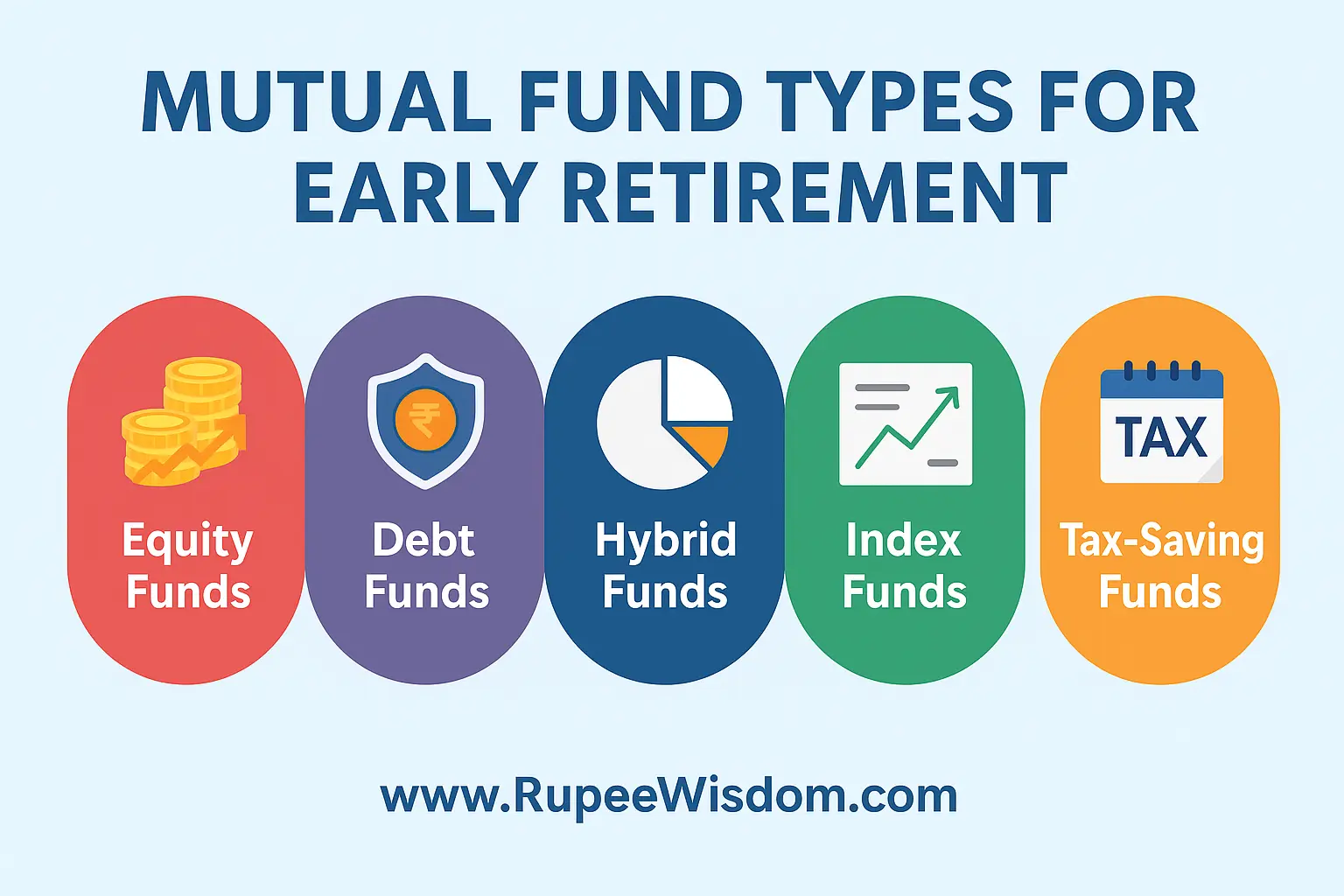
Before picking schemes and SIPs, let’s understand why mutual funds deserve the centre stage in your early-retirement plan.
- Compounding power kicking in: Start young and your returns have decades to compound. That multiplier effect is what turns modest monthly SIPs into larger than expected corpus down the line.
- Equity over long term beats inflation: Indian money loses value quickly thanks to inflation. Equity-oriented funds historically outperform inflation significantly, giving you a chance to build a real retire-early corpus.
- Automatic investments = discipline: SIPs (Systematic Investment Plans) force you to save first, spend later. As the Indian mutual-fund space evolves you’ll find better options for discipline, diversification, and low minimums.
- Portfolio flexibility: With mutual funds you can shift asset-allocation over time—from aggressive to more conservative—as you approach your early-retirement date.
- Tax and transparency advantages: Indian mutual funds now offer direct plans, clearer expense ratios, easy tracking. That matters when you’re planning for years or decades.
So yes—the mutual-fund strategy is right for early retirement in India. The question is: how to structure it, manage it, optimise it and avoid common early-retirement traps.
Set your target: What does “early retirement in India” really mean?
Before we talk strategy, you need a clear number and timeline. Here’s how to set that up.
Step 1: Define “early”
For you, early might mean age 45, 50 or even 55. The younger you want to retire, the more aggressive and disciplined your strategy must be.
Step 2: Calculate required corpus
Here’s a simple formula:
Required Corpus ≈ Annual-Spending × (1 ÷ Safe Withdrawal Rate)
In India you might target a safe withdrawal rate (SWR) of 3–4% (more conservative than western numbers) because you’re retiring early and need the money to last a long time.
Example: You spend ₹12 lakh/year after inflation adjusting. If you use 4% SWR → Corpus = ₹12 lakh ÷ 0.04 = ₹3 crore.
According to SEBI, investors should verify mutual fund details, expense ratios, and advisor credentials before investing. Following SEBI-registered financial guidelines ensures your early retirement in India strategy stays compliant and low-risk.
Step 3: Assess timeline
If you’re 30 now and want to retire by 50 → 20 years. If you’re 40 → 10 years. Smaller time → you need more monthly savings or higher portfolio growth.
Step 4: Decide risk budget and buffer
Retiring early means you’ll live off investment returns longer. So you’ll need:
- A growth phase (high equity) initially.
- A buffer (emergency savings, health cover).
- A withdrawal plan and fallback plan in case markets fall.
With that in mind, let’s move into the proper mutual-fund strategy.
The best mutual fund strategy for early retirement in India
Here’s how you’d build a strategy across phases, asset allocation, tax aspects and review process.
H2 – Best mutual fund strategy for early retirement in India: Phase-by-phase
Phase 1: Growth phase (T minus 10-25 years)
During this period your main goal: maximise growth. You’re far from retirement, so you can afford risk and higher equity exposure.
- Asset allocation: ~70-90% equity, 10-30% debt or debt funds.
- Focus: Large-cap + multi-cap + mid-cap funds (if you tolerate risk).
- Use SIPs monthly—discipline counts more than timing.
- Choose direct plans of mutual funds to reduce cost drag.
- Example: If you begin at 30 wanting to retire at 50, you may keep 80% equity: 60% large/multi-cap, 20% emerging/mid-cap; 20% in debt/stabiliser.
- Give yourself room for volatility. If you lose 30% in a market crash, you’re still 15-20 years away—probability says you’ll catch up.
Over the past decade of tracking SIP performance and real investor behaviour, our team noticed a consistent pattern — investors who began their equity SIPs before age 30 accumulated nearly 60% higher corpus by 50 than those who started after 35. The difference wasn’t luck; it was simply time in the market and disciplined rebalancing.
Phase 2: Transition phase (T minus 5-10 years)
Once you are 5-10 years away from your target early-retirement date, you begin shifting the risk:
- Equity reduces gradually to maybe 50-60%.
- Increase allocation to debt funds, stable-value funds, even fixed income.
- Introduce hybrid or balanced funds that provide both growth and more control.
- Continue SIPs but begin thinking of “pre-retirement buffer” – maybe build 1-2 years’ spending in a liquid fund so you don’t force withdrawals during a downward market turn.
Phase 3: Withdrawal/pre-retirement phase (retirement imminent)
By the time you retire early:
- Equity might be ~40-50% (higher if you have long investment horizon even post-retirement).
- Debt/Hybrid ~50-60% to provide stability.
- Have a “reserve bucket” of 1-2 years’ expenses in ultra-liquid or short-term debt funds.
- Start using SWP (Systematic Withdrawal Plan) from mutual funds: so you’re not forced to sell at a bad time.
- Monitor expenses strictly; you’ll no longer have salary as fallback.
Practical steps: Picking and managing mutual funds for early retirement
Step 1: Set up the SIPs
- You don’t need a huge lump sum to start—₹2,000−₹5,000₹2,000-₹5,000₹2,000−₹5,000/month works if you start early.
- Automate. Give your SIP date early in the month so it captures salary.
- Increase SIP amount annually (say by 5-10%) or whenever you see a raise/increment.
Step 2: Choose fund types wisely
- Large/Multi-cap equity funds: Core growth engine.
- Mid-cap/emerging equity funds: Higher risk/higher return—good if you have >10 years.
- Balanced/hybrid funds: Good during transition phase when you’re reducing risk.
- Liquid/short-term debt funds: For buffers and stability.
Step 3: Cost, taxes & expenses
- Direct plans > Regular plans: Expense ratio matters.
- Equity funds held >1 year: Long-term capital gains (LTCG) at 10% for gains over ₹1 lakh/year. Factor tax into net returns.
- Balanced/hybrid & debt funds: tax treatment varies (short/mid term capital gains). Early retirement strategy must account for tax-drag.
Step 4: Asset rebalancing
- At least once a year, check your actual vs target allocation. Markets will distort your chosen mix.
- Rebalance by redirecting new SIPs or switching small amounts—not full churn.
- Use transitions (phase 2) to shift toward safer funds gradually.
Step 5: Monitor and adjust
- Review fund performance (5-year rolling returns compared to benchmark).
- Check fund manager changes, expense ratio, AUM, risk metrics.
- Avoid chasing “top performing fund of last 1 year” only.
- Keep eyes on macro factors—interest rates, inflation, global risk—because early retirement means you cannot ignore these.
Step 6: Emergency & insurance planning
- Before and during your early retirement planning, ensure: life cover, health cover (critical especially if you retire early), personal accident cover. This protects corpus from being eaten by medical/insurance emergencies.
- Have a solid emergency fund (6-12 months of expenses) outside your investment corpus.
Sample “early retirement mutual fund” plan for Indian investor
Let’s walk through a sample scenario to make this concrete.
Example
- Age: 35
- Target retirement age: 50 (15 years to go)
- Current monthly saving potential: ₹30,000
- Expected annual inflation: 6%
- Current annual post-inflation spending expectation at retirement: ₹10 lakh
Step A: Future spending = ₹10 lakh * (1.06^15) ≈ ₹24 lakh/year at age 50.
Step B: Required corpus using 4% SWR = ₹24 lakh ÷ 0.04 = ₹6 crore.
Step C: Build SIP strategy:
- Allocate SIP monthly: ₹30,000 to equity-oriented funds (70%) and debt/hybrid (30%).
- Increase SIP by 7% every year (to beat inflation and salary increase).
- Suppose average real return (post inflation) from equity 10% pa, debt/hybrid 5% pa.
- After 15 years, rough estimate: Equity portion grows to ~₹1.5 crore, debt/hybrid ~₹0.5 crore → total ~₹2 crore (assuming no lump sum).
- You see gap vs target ₹6 crore → you’ll need to either increase saving to ₹50,000/month or extend retirement age / accept lower spending.
This sample shows the math: early retirement with mutual funds works—but you need discipline, realistic numbers and flexibility.
Key mistakes to avoid when implementing your mutual fund strategy
- Waiting too long to start investing: The biggest loss is lost time. The compounding engine stalls.
- High-risk chasing without exit plan: If you’re retiring early and rely heavily on mid-cap or small-cap, a market crash near transition phase can wreck your plan.
- Ignoring cost/taxes: Expense ratio, exit loads, taxes reduce net returns.
- No buffer for market downturns: If you force withdrawals from a falling portfolio, you damage long-term survival.
- Slacking on emergency/insurance: Retiring early means you’ll cover many years of risk yourself—health costs, longevity risk.
- Not adjusting lifestyle/spending assumptions: Early retirement often means your spending pattern will evolve—keep realistic about inflation, healthcare, desire for travel and hobbies.
Workflow checklist: Execute your strategy today
- Decide your retirement age and current spend / future spend estimate.
- Compute required corpus using Safe Withdrawal Rate (3-4%).
- Set monthly investment amount in mutual funds (choose SIP date and amount).
- Choose fund mix: large/multi-cap, mid/emerging, hybrid, debt.
- Open direct mutual fund plans via online platform (Select low cost AMC, check expense ratios).
- Automate investments (SIP).
- Annually review portfolio allocation and rebalance.
- Increase SIP amount by at least P% each year (reflect salary inflation).
- Keep 2 years of expenses as buffer in liquid/ short-term debt fund when you’re 5 years away from retirement.
- Secure comprehensive health and life insurance cover.
- Every 3-5 years re-compute your target corpus because inflation, tax laws, returns may change.
How market behaviour, inflation and tax affect your plan
- Inflation: India’s inflation historically ~5-7% for consumer goods, higher for healthcare. Your spending estimate must anticipate this.
- Taxation: Equity LTCG in India is taxed at 10% for gains beyond ₹1 lakh/year. Debt funds have different tax slabs. Assume net returns after tax will be a bit lower.
- Market cycles: You will see bear markets. But if you are 10-20 years away from early retirement, such cycles are manageable. When you’re in transition phase, you must reduce equity risk.
- Withdrawals risk: If you retire early and the market is down, you’ll suffer more because your time horizon is long. That’s why buffer and phased transition matter.
Frequently Asked Questions (FAQ)
Q1. What is the minimum SIP I should start with?
There’s no universal answer—it depends on your timeline and target. If you start 20 years ahead, maybe ₹10,000/month is fine; if you start 5 years ahead, you may need ₹50,000+ or more.
Q2. Can I retire early only with mutual funds?
Yes—if your corpus, timeline, investment consistency and risk buffer are managed. But you should not only rely on one asset class. Mutual funds can be the core, but you also need emergency funds, insurance, maybe alternate income streams.
Q3. Which mutual funds should I pick right now for early retirement in India?
Focus on the broad categories—large/multi-cap equity for growth, hybrid/balance funds for transition, short-term debt/liquid funds for buffer. Specific schemes will change; apply the model, not chase last year’s top performer.
Q4. What happens if the market crashes near my retirement date?
That’s exactly why we shift from Phase 1 to Phase 2 & 3. You’ll have more allocated to debt/hybrid, plus a buffer of 1-2 years expenses in liquid funds so you don’t sell everything in a down cycle.
Q5. What safe withdrawal rate should I consider for early retirement?
For early retirement in India you should be conservative: 3-4% is a prudent assumption because you may live 30-40 years post-retirement.
Final thoughts & conclusion
If you want early retirement in India—and I mean really quitting work and living off your investments—then a well-designed mutual fund strategy is your best ally. The key lies in starting early, being consistent, choosing direct plans, using SIPs, monitoring risk, and adapting the asset allocation over time.
Here’s the bottom-line:
- Calculate your target corpus now (don’t wait).
- Choose your risk budget and align your mutual-fund portfolio accordingly.
- Automate and increase your investment every year.
- Protect yourself with insurance and buffer funds.
- Transition wisely as you get closer.
- And above all—stay invested through both bull and bear markets.
If you follow this blueprint, your best mutual fund strategy for early retirement in India becomes not just a dream—but a realistic roadmap. Your future self will thank you for starting today.