If you’re trying to understand how to retire at 40, especially in India where financial responsibilities are different, this guide gives you a complete, no-nonsense roadmap. You’ll learn exactly what early retirement requires, how much money you need, how to build it, how to protect it, and how to create the lifestyle that lets you choose work instead of needing work.
Early retirement isn’t about being rich — it’s about being strategic. It’s about controlling your income, investments, lifestyle, and decisions long before society thinks you “should.” If you’ve thought even once about how to retire at 40, you’re already thinking smarter than 95% of people.
Why People in India Want to Retire at 40 Now
The idea of retirement at 60 is outdated. The world has changed. Skill-based income, remote work, compounding, digital opportunities, and new-age investments have made early retirement possible even for average earners with strong planning.
People now think:
Why work 40 years to enjoy 10 years, when you can work 15–20 years and enjoy 40?
That’s why how to retire at 40 has become one of the fastest-growing financial goals in India. And with the right strategy, it’s genuinely achievable.
What “How to Retire at 40” Actually Means
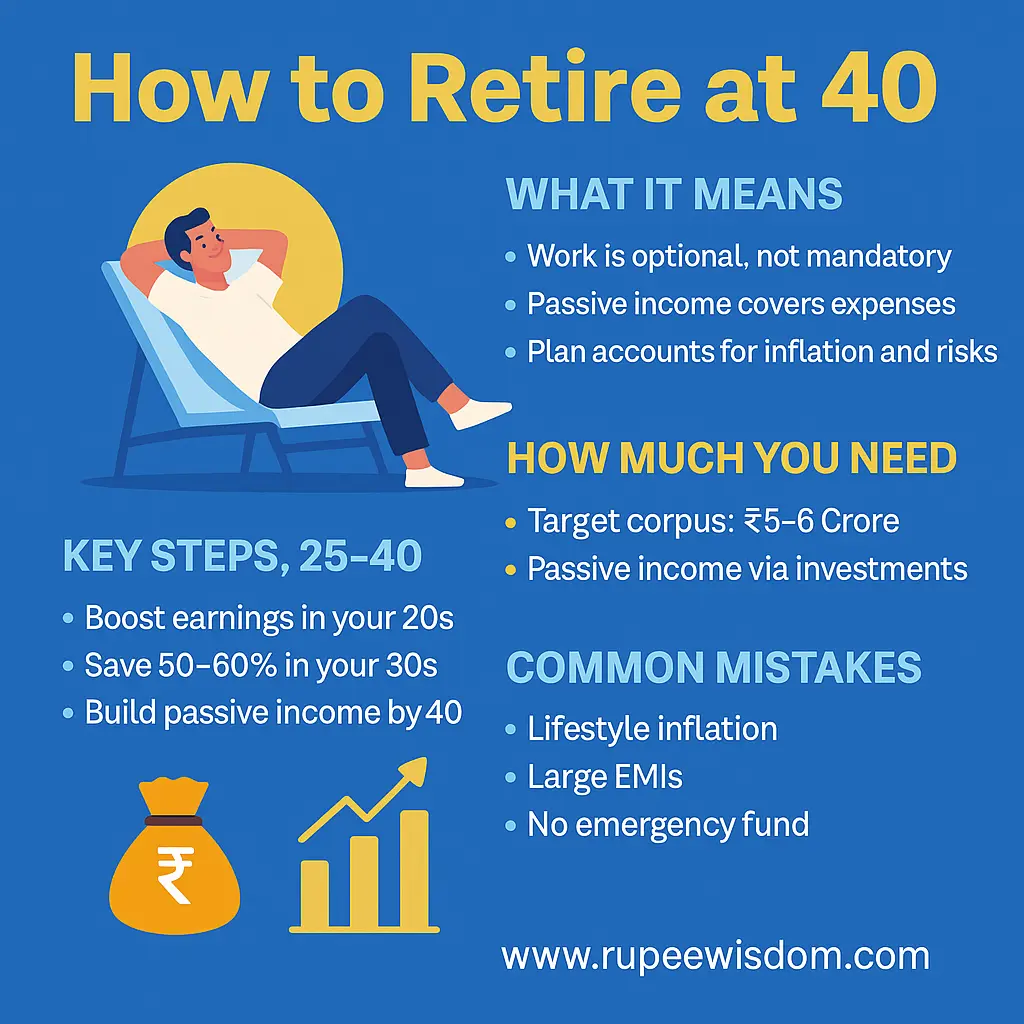
Let’s clear the air. Retiring at 40 doesn’t mean:
- sitting home doing nothing
- giving up growth
- switching off mentally
- depending on someone else
- living extremely cheap
Retiring at 40 means:
- You stop depending on a job
- You work only if you WANT to
- Your money generates income for you
- You have a clear, inflation-proof plan
- You have safety nets for health and emergencies
- You gain TIME freedom
This life is very possible — but only if you understand how to retire at 40 with real Indian financial conditions in mind.
The Exact Amount You Need to Retire at 40 in India
If you don’t run the numbers correctly, early retirement collapses like a house of cards. So let’s do the math honestly.
Step 1: Know Your Annual Spending at Age 40
To understand how to retire at 40, calculate your future lifestyle cost including:
- housing
- groceries
- transport
- travel
- healthcare
- children’s needs
- parents’ support
- entertainment
- emergencies
- lifestyle upgrades
Most Indians aiming for comfortable early retirement fall in the range of ₹12–18 lakh per year.
Try the early retirement calculator to test different expense, inflation and return assumptions.
Step 2: Multiply It by 25–30
This rule is the backbone of early retirement.
So for ₹15 lakh per year:
- 25× = ₹3.75 crore
- 30× = ₹4.5 crore
But since you’re retiring VERY early, the smarter goal is:
Target Corpus: ₹5–6 crore minimum
Once you understand this math, the question “how to retire at 40” becomes a clear financial target instead of a mystery.
Step 3: Consider Inflation
India has higher inflation. What costs ₹1 lakh today might cost ₹1.7–2 lakh in 10–12 years. So your plan must stay ahead of inflation.
Step 4: Invest in a System That Pays You
Your early retirement income should come from:
- equity growth
- dividends
- rental yield
- debt interest
- small business/side income
- systematic withdrawals
This is how to retire at 40 without worrying every month.
The 15-Year Roadmap (Age 25 to 40)
This is the practical, Indian-specific path people follow to retire at 40.
Age 25–30: The Foundation Stage
If you want to know how to retire at 40, the game begins here.
Your focus in your 20s:
Increase income → reduce expenses → kill debt → start investing → build habits.
Actions:
- Learn high-income skills
- Switch jobs strategically
- Do freelancing/side gigs
- Save minimum 40% of your income
- Invest from your first salary
- Build a 6–12 month emergency fund
- Avoid unnecessary EMIs
- Stay away from credit card debt like it’s poison
- Live below your means
This is where early retirement is born.
Age 30–35: The Growth & Compounding Stage
This is the MOST important 5-year window for retiring at 40.
Your income increases significantly. Your savings rate increases. Your investments start compounding seriously.
Actions:
- Save and invest 50–60% of your salary
- Maintain high equity exposure for growth
- Automate SIPs
- Add a side income source
- Maximise tax-efficient investing
- Do NOT upgrade your lifestyle because income increased
- Avoid big EMIs
- Build real assets
- Track your net worth regularly
If you do these years perfectly, understanding how to retire at 40 becomes straightforward.
Age 35–40: The Security & Passive Income Stage
Now you protect and stabilise everything you’ve built.
Actions:
- Shift a portion to safer assets
- Create predictable passive income
- Diversify your investment portfolio
- Strengthen health insurance
- Keep expenses under control
- Build a 2–5 year cash cushion
- Remove all toxic debt
- Prepare your “post-retirement income sources”
By age 40, you should have:
- your full corpus
- your passive income strategy
- your risk protection
- your lifestyle setup
- your peace of mind
This is exactly how to retire at 40 with confidence.
Read the complete step-by-step early retirement guide for deeper tactics and expanded examples.
Major Traps That Stop People From Retiring at 40
If you fall into these traps, your dream of early retirement dies.
1. Lifestyle Inflation
The #1 retirement killer.
Income rises → spending rises faster → savings stay the same.
2. Big EMIs
Huge home loans or fancy car EMIs make retiring at 40 impossible.
3. No Emergency Cushion
One emergency, and you’re back to zero.
4. Ignoring Inflation
People plan for today, but you’re retiring for 40+ years.
5. Investing Only in One Asset
100% equity? Risky.
100% real estate? Risky.
100% FD? Risky.
Balance matters.
6. Depending Only on Salary
If you lose your job, the plan collapses.
Avoid these and your “how to retire at 40” plan becomes unstoppable.
The Perfect Investment Mix to Retire at 40
A strong Indian early-retirement portfolio typically includes:
Equity Funds
Main source of long-term growth and compounding.
Debt Instruments
Stability as you approach 40.
SIPs
The most disciplined and automatic investment method.
Gold (Small Allocation)
Inflation protection.
Real Estate (Selective)
Only if EMIs are manageable and yield is decent.
Side Income Streams
Consulting, freelance work, digital products, rentals — all help reduce pressure on your corpus.
Knowing how to retire at 40 isn’t enough — you need the right investment engine behind you.
Mindset Shifts Required to Retire at 40
This is the part no one talks about — but it’s more important than the math.
Live Intentionally
Not cheap — simply smart.
Automate Your Investments
Automation beats motivation every time.
Avoid Showing Off
The goal is freedom, not impressing relatives at weddings.
Be Comfortable Saying “No”
No to EMIs.
No to lifestyle pressure.
No to unnecessary upgrades.
Review Your Plan Every Year
Your life changes. So should your financial map.
Focus on Freedom, Not Status
People who retire early value time more than logos.
This mindset is the secret behind how to retire at 40 successfully.
What Life Looks Like When You Retire at 40
Imagine this:
- You wake up without an alarm
- You work only if you want to
- You earn from investments, not stress
- You spend time with family
- You travel when others are busy
- You pursue hobbies, fitness, and passion projects
- Your stress drops
- Your health improves
- You live on your own terms
This is the real reward of learning how to retire at 40.
A Realistic Indian Example of Retiring at 40
Here’s one scenario that many people achieve:
- Age 25: Annual salary ₹10 lakh → save ₹4 lakh
- Age 30: Salary ₹18 lakh → save ₹9 lakh
- Age 35: Salary ₹30 lakh + side income ₹5 lakh → save ₹18–20 lakh
- Age 40: Investments grow to ₹4–6 crore
Plus:
- rental income
- dividends
- stable side income
Total passive income = ₹15–20 lakh/year
Enough to live comfortably in most Indian cities.
This is how to retire at 40 — not fantasy, just math.
India-Specific Challenges You Must Prepare For
Early retirement in India comes with unique realities:
Higher Inflation
Use 6–7% in your calculations.
Health Costs
Private healthcare is expensive — insurance is mandatory.
Family Responsibilities
Parents, children, extended family — all must be part of the plan.
No Pension Systems
Your investments are your pension.
Social Pressure
People may judge you, misunderstand you, or assume you’re jobless.
Ignore them — most people are financially stressed.
Understanding these challenges is crucial to mastering how to retire at 40.
The 12-Point Early Retirement Checklist
Before you quit work at 40, ensure:
- Corpus target achieved
- Passive income sources ready
- Emergency fund full
- No toxic debt
- Solid health and life insurance
- Investments diversified
- 2–5 year cash cushion
- Clear spending plan
- Family commitments covered
- Liquidity available
- Part-time income option ready
- Mindset prepared for freedom
Complete these, and your “how to retire at 40” plan is rock solid.
Conclusion
Learning how to retire at 40 in India and actually doing it are two different things — but absolutely achievable for anyone willing to live intentionally, invest consistently, manage lifestyle wisely, and think long-term.
Retiring at 40 is not about luck. It’s not about having a rich family. It’s not about earning crores. It’s simply about building wealth strategically, avoiding bad financial decisions, and letting compounding work for you.
Start today. Stay disciplined. Achieve FIRE!
The freedom you’ll feel at 40 is worth every sacrifice in your 20s and 30s.