
Retirement used to mean slowing down after sixty. But that definition is changing fast — especially in India. Many people today dream of stepping away from the 9-to-9 grind far earlier. Whether it’s 40, 45, or 50, learning how to retire early in India is about one thing: freedom.
It’s not about being lazy or escaping work — it’s about having the choice to work when and how you want. Imagine waking up when you’re ready, not when the alarm says so. That’s what financial independence feels like.
But let’s be honest: retiring early in India isn’t easy. Inflation, family responsibilities, and unpredictable expenses can make it challenging. Still, if you plan right and start early, it’s absolutely possible. Let’s dive into the practical, step-by-step plan that shows exactly how to retire early in India — no fancy jargon, just real, actionable advice.
Why So Many Indians Want to Retire Early
Work stress, long commutes, rising health issues — Indians are burning out faster than ever. At the same time, financial awareness has grown. People now understand that freedom doesn’t come from earning more; it comes from controlling money better.
Retiring early gives you time — the most valuable currency. Time for your family, your passions, your health, and your peace of mind. And yes, it’s possible to achieve that in India, even if you don’t earn crores.
But you’ll need discipline, clarity, and a long-term plan — not just random investments.
How to Retire Early in India the Smart Way
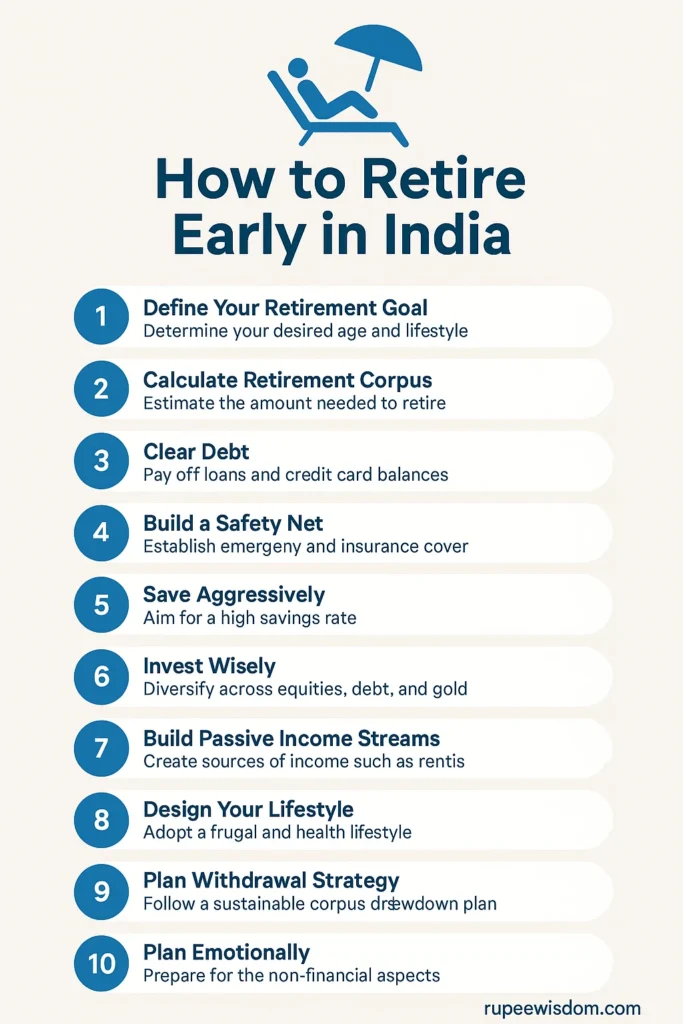
If you genuinely want to understand how to retire early in India, it’s not about earning millions overnight — it’s about building financial discipline, planning smartly, and acting early. Early retirement in India requires a strategy that blends savings, investment, and lifestyle design. Let’s break it down step by step so you can build a plan that actually works in the Indian context.
Want to Retire at 40 in India?
A simple, actionable roadmap to hit early retirement in the Indian market.
Read the guide →Step 1: Define What “Early Retirement” Means to You
Before you learn how to retire early in India, define what “retirement” means for you personally.
For some, it means complete financial independence — no active income needed. For others, it means switching from a full-time job to passion-based projects or freelancing.
Ask yourself:
- What age do I want to retire? (45? 50?)
- What will my lifestyle look like post-retirement?
- Who depends on my income?
- Will I live in a metro or shift to a smaller city?
This clarity is your foundation. You can’t build a plan without a goalpost.
Step 2: Calculate How Much You’ll Need to Retire Early in India
Now comes the math behind how to retire early in India — your retirement corpus.
A good rule of thumb:
- If you plan to retire at 60, you need 25× your annual expenses.
- If you plan to retire early (say 45–50), aim for 30–35× your annual expenses.
Let’s say your annual expenses today are ₹10 lakh. To retire at 45, you’ll need around ₹3–3.5 crore.
This number sounds intimidating, but remember — it’s not overnight money. You’ll build it over years of saving, investing, and compounding.
And don’t forget inflation. In India, inflation averages around 6%. What costs ₹10 lakh today might cost ₹20–25 lakh in 15 years.
So, when you calculate how to retire early in India, always add a healthy buffer.
Step 3: Clear Debt — The Fastest Way to Speed Up Retirement
Debt is the biggest enemy of early retirement. You can’t chase financial freedom while paying EMIs every month.
Here’s your game plan:
- Pay off high-interest debts first (credit cards, personal loans).
- Avoid lifestyle loans — don’t buy gadgets or cars on EMI.
- Refinance or prepay your home loan if it eats up more than 30% of your income.
- Keep one credit card, pay in full every month, and never revolve balance.
Every rupee that’s not going toward interest is a rupee that can grow your wealth. Clearing debt fast is a powerful shortcut if you’re serious about how to retire early in India.
Step 4: Build a Safety Net Before You Invest
Even the best investment plan can crumble if you don’t have safety nets. Before you think about returns, secure the basics:
- Emergency Fund: Save at least 6–12 months of living expenses. Keep it in a liquid fund or savings account.
- Health Insurance: In India, a single hospitalization can cost lakhs. Get family coverage of at least ₹10–15 lakh.
- Term Insurance: Protect your family. Cover = 10–15× your annual income.
Without this protection, one emergency can wipe out years of savings. Smart retirement planning starts with risk protection.
Step 5: Save Aggressively — Your Freedom Rate
To understand how to retire early in India, you must understand this:
The faster you save, the sooner you can retire.
If you’re serious about early retirement, target saving 40–60% of your income.
Here’s how:
- Keep your fixed expenses below 50% of income.
- Avoid expensive gadgets, cars, or frequent takeaways.
- Upgrade your income skills — every increment should increase your savings rate, not your lifestyle.
Automate it. SIPs, recurring deposits — let your savings leave your account before you even see them.
You can also read more about financial independence and retirement basics on RBI’s Financial Education Portal, which simplifies personal finance concepts for Indian readers
Step 6: Invest Wisely — Make Your Money Work for You
Now comes the engine that drives your early retirement: investing smartly.
Here’s a realistic Indian-style allocation:
| Asset Type | Purpose | Allocation |
|---|---|---|
| Equity Mutual Funds / Index Funds | Growth | 60–70% |
| Debt Funds / Fixed Deposits | Stability | 20–25% |
| Gold ETFs / Bonds | Inflation protection | 5–10% |
| Liquid Funds / Cash | Emergency | 5% |
Key rules when planning how to retire early in India:
- Start SIPs early, even small ones. Compounding does the heavy lifting.
- Avoid pausing investments when markets dip — buy more instead.
- Rebalance yearly — shift profits gradually from equity to debt as you near retirement.
- Don’t chase “hot” schemes or crypto — sustainable growth wins the marathon.
Your goal isn’t to beat the stock market — it’s to beat your expenses.
Step 7: Build Passive Income Streams
Even if your corpus is ready, you’ll feel safer knowing you have passive income.
Ways to do this in India:
- Rental Income: Ideal if you own property, but don’t rely entirely on it.
- Dividends from Equity or Mutual Funds: Use this as supplemental income.
- Freelancing / Consulting: Turn your skills into flexible part-time income.
- Online Income: Blogs, courses, or YouTube — all viable in your 40s or 50s.
The secret to how to retire early in India isn’t only saving. It’s also creating multiple small streams of money that keep flowing when your job stops.
Step 8: Lifestyle Design — The Hidden Weapon
Retiring early in India isn’t about having ₹10 crore. It’s about designing a lifestyle that doesn’t cost a fortune.
- Move to smaller cities where life is calmer and costs are 40% lower.
- Buy experiences, not expensive possessions.
- Eat healthy, exercise, and reduce medical dependency — health is a huge financial asset.
- Avoid social comparison — that’s where most people’s money vanishes.
The less your lifestyle costs, the faster you can retire.
Step 9: Withdrawal Strategy After Retirement
Once you’ve achieved your goal, your next challenge is making the corpus last.
- Withdraw 3–4% per year from your total corpus.
- Keep part of your investments in equities (30–40%) even post-retirement to fight inflation.
- Reinvest unused returns.
- Maintain a small emergency fund — never fully lock everything into long-term products.
Knowing how to retire early in India also means knowing how to stay retired comfortably for 30+ years.
Step 10: Plan Emotionally, Not Just Financially
Early retirement sounds glamorous, but it can shock people mentally.
After decades of routine, suddenly having full control over your day can feel strange. Plan your post-work identity.
What will you do when you retire?
- Travel?
- Volunteer?
- Mentor others?
- Start a small business?
Having purpose keeps your mind sharp and your life meaningful.
Common Mistakes People Make While Planning Early Retirement
- Ignoring inflation. Expenses double every 12–15 years.
- Investing only in real estate. Property is illiquid.
- Starting late. Every 5 years of delay doubles the work.
- Depending on kids. Modern India doesn’t guarantee that.
- Neglecting health insurance. One illness can destroy everything.
- Believing a single mutual fund SIP solves it all. Diversify smartly.
Avoid these, and your path to financial freedom becomes much smoother.
Example: Retiring Early in India at 45
Let’s say you’re 30 years old and want to retire by 45 — you have 15 years.
- Current monthly expenses: ₹80,000
- Future monthly expenses (inflation 6%): ₹1.9 lakh
- Annual = ₹22.8 lakh
- Retirement corpus = ₹22.8 lakh × 30 = ₹6.8 crore
To achieve that, you’ll need to invest about ₹65,000–₹70,000 per month at an average 12% annual return.
Increase this by 10% yearly as your salary grows, and you’ll get there.
That’s how to retire early in India — not luck, not lottery — consistent planning.
Your 5-Point Checklist for Early Retirement
✅ Track every expense — what you measure, you control.
✅ Save before you spend — automate it.
✅ Invest regularly and review annually.
✅ Protect with insurance.
✅ Keep learning — personal finance evolves.
Master these habits, and the idea of retiring early in India stops being a dream and becomes a goal.
The Mindset Shift That Changes Everything
Money alone won’t retire you — mindset will.
People who achieve early retirement don’t necessarily earn more. They just think differently.
They value time over things. They live intentionally, spend consciously, and prioritize peace over pressure.
If you truly want to learn how to retire early in India, start rewiring your thinking:
- Replace “I can’t afford this” with “Is this worth delaying my freedom for?”
- Replace “I’ll start later” with “Later means never.”
Every smart choice brings you one step closer to independence.
Conclusion
Learning how to retire early in India isn’t about luck or high income — it’s about discipline, clarity, and commitment.
Start with debt freedom, build safety nets, invest wisely, and live intentionally.
Your goal isn’t to escape work — it’s to escape financial pressure.
You don’t need to be a millionaire to retire early in India. You just need to master the basics, stay consistent, and value freedom more than luxury.
The earlier you start, the sooner you’ll live life on your own terms — and that’s the real definition of wealth.